
How to get your business mentioned in ChatGPT
August 24, 2026
Facebook Ads vs Google Ads for lead generation
August 31, 2026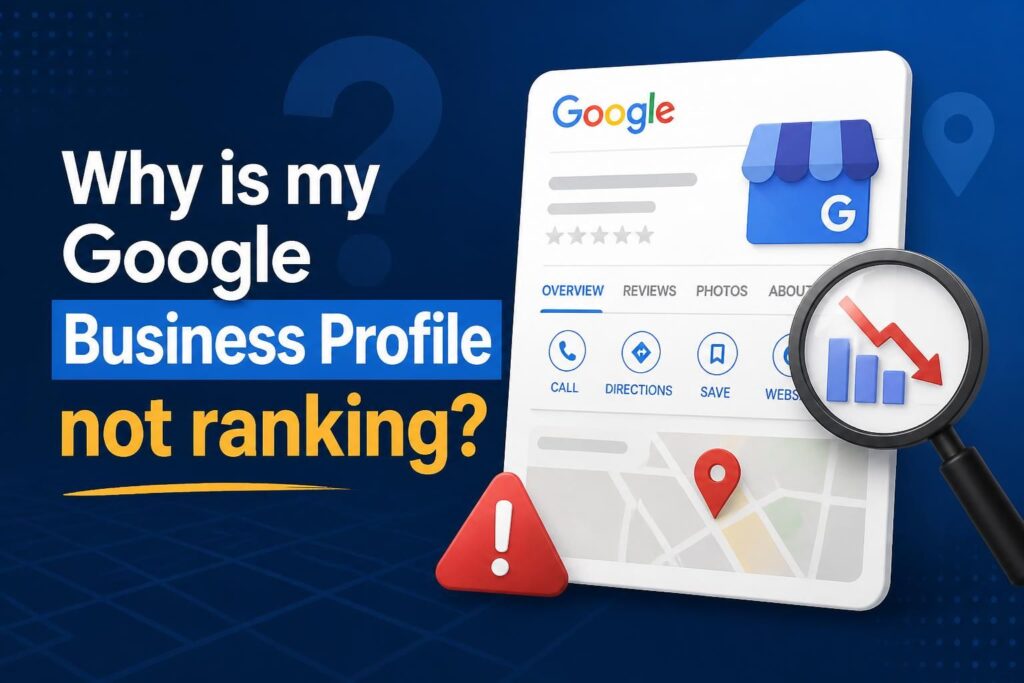




If your Google Business Profile is not ranking, the cause usually falls into one of four areas: Google does not see the business as relevant to the search, the searcher is too far from the verified location, competitors have stronger local prominence, or the profile has an eligibility or quality problem. Rankings can also vary from one suburb, device and search phrase to another, so a single manual search does not provide a complete diagnosis.
Improving visibility starts with identifying the specific problem rather than repeatedly editing the profile. Check whether the listing appears for the business name, which services trigger it, where visibility drops, and whether the website supports the same business details. The sections below explain how Google evaluates local results and what South African business owners can do to improve qualified local exposure.
Other Siteweb services that support local lead generation
A Google Business Profile works best as part of a connected marketing strategy. Siteweb Online Marketing can assist with Google Business Profile optimisation, targeted Google Ads management, search engine optimisation, generative engine optimisation and social media marketing. These services address different stages of visibility, trust and lead generation rather than relying on one marketing channel.
How Google decides which local businesses to show
Google states that local results are mainly based on relevance, distance and prominence. There is no profile setting that overrides all three factors, and businesses cannot request or pay Google for a better organic local ranking. Google combines information from the profile, the linked website, customer activity and other sources to estimate which businesses are most useful for a particular local search.
- Relevance: How closely the business information matches what the person searched for.
- Distance: How far each eligible business is from the searcher or the location named in the query.
- Prominence: How established and well known the business appears online and, in some cases, offline.
This explains why a profile may rank well for its business name but not for a competitive service query. A business can be verified and fully completed without being one of the strongest results for every service or location it wants to target.
First determine whether the profile is missing or simply ranking poorly
A missing profile and a low-ranking profile require different fixes. Search for the exact business name while signed out of the account that manages the listing. If the profile appears, it is probably eligible and indexed, but may lack relevance or prominence for non-branded searches. If it does not appear for the exact name, investigate verification, status, duplicates and policy issues before changing categories or content.
Use this diagnostic sequence:
- Search the exact business name and town or suburb.
- Open the profile and confirm that the public name, address, telephone number and website are correct.
- Check the Google Business Profile management interface for verification prompts, restrictions or suspension notices.
- Search Google Maps for the telephone number or address to find possible duplicate listings.
- Test a small group of genuine service searches from more than one location.
- Compare the profile with businesses that consistently appear above it.
Do not make several major edits at once. Changing the name, category, address, service area and website simultaneously makes it difficult to identify what helped, and significant edits may prompt reverification.
Common reasons a Google Business Profile does not rank
The primary category does not match the core business
The primary category is one of the clearest signals describing what a business is. It should represent the main business activity, not every service the company would like to sell. Secondary categories can cover genuine additional activities, but adding loosely related categories may weaken clarity rather than expand visibility.
Review the categories used by relevant competitors, but do not copy them without checking whether they accurately describe your own operation. Category options change over time and differ by business type. Choose the most specific valid category available, then use services, the business description and the website to provide supporting context.
The business information is incomplete or inconsistent
Google needs confidence that the profile represents a real business at the stated location or within the stated service area. The business name, address and phone number should be accurate and should agree with the linked website and other important public references. Minor formatting differences are rarely the main issue, but conflicting phone numbers, old addresses and duplicate profiles can create uncertainty for users and search systems.
Complete the fields that genuinely apply, including opening hours, holiday hours, website, appointment links, services and business description. Accuracy matters more than filling every field. Do not list services the business does not provide or use an address where the company is not eligible to receive customers.
The business name contains added keywords
Adding a service, suburb or marketing phrase to the profile name may appear to improve rankings temporarily, but it conflicts with Google guidelines unless those words form part of the real-world business name. Examples include adding phrases such as “best plumber Johannesburg” or “SEO company Cape Town” when they are not used consistently on signage, stationery and branding.
Name edits can trigger verification checks, user-suggested changes or enforcement action. Use the genuine business name and build service relevance through categories, website pages, services, reviews and supporting content.
The searcher is outside the area where the profile is competitive
Distance is often the reason a profile ranks in one suburb but disappears several kilometres away. Setting a large service area does not make the business rank throughout that entire area. Service areas tell customers where a business operates; they do not relocate the verified base or remove proximity from local ranking calculations.
This is especially relevant in large South African metros where users in neighbouring suburbs can receive different map results. A business should assess visibility from realistic customer locations instead of assuming that one ranking applies across Johannesburg, Pretoria, Cape Town, Durban or an entire province.
The website does not support the profile
A thin, outdated or poorly structured website can limit the evidence available to Google. The linked landing page should clearly identify the business, explain its main services, provide accurate contact details and help visitors understand the areas served. Relevant service pages are more useful than repeating a long list of towns in a footer.
Technical problems also matter. Check that the website is accessible to search engines, mobile friendly, served securely and free from accidental noindex instructions. A proper SEO review can uncover indexing, content and internal-linking problems that profile edits alone cannot solve.
Competitors have stronger prominence signals
Prominence is built through a combination of signals. Reviews are visible and influential, but they are not the only consideration. A competing business may have stronger local links, more complete service content, wider brand recognition, longer-standing citations or more consistent customer engagement.
Focus on signals that can be improved legitimately. Earn links from relevant local organisations, suppliers, industry bodies and community partners where a genuine relationship exists. Keep important directory listings accurate. Publish useful service information on the website, and make it easy for satisfied customers to leave honest reviews.
Reviews are too few, too old or handled poorly
Review quantity, recency, quality and the overall pattern can affect customer confidence and may contribute to local prominence. A steady flow of genuine feedback is more credible than a sudden burst of reviews. Ask customers after a completed transaction and make the process simple, but never offer incentives or create reviews on behalf of customers.
Respond to positive and negative reviews professionally. Replies should address the customer rather than being packed with search phrases. If a review violates Google policy, report it through the available process; do not assume that every critical review qualifies for removal.
The profile has a duplicate, verification or eligibility problem
Duplicate profiles can split reviews and confuse customers. A listing may also lose visibility after an address change, ownership dispute, category change or verification failure. Businesses that operate entirely online without eligible face-to-face customer contact generally do not qualify for a Google Business Profile. Virtual offices and locations without a genuine business presence can also create eligibility problems.
If a profile is suspended, correct the underlying information before submitting an appeal. Creating a replacement listing to bypass enforcement can make the situation more complicated. Keep registration, utility, signage or other legitimate business evidence available if Google requests proof during verification or reinstatement.
A practical plan for improving local visibility
1. Establish a reliable ranking baseline
Record the profile’s current performance before making changes. Select a limited group of commercial searches that accurately reflect the services customers buy. Test from several relevant locations and note whether the business appears in the local pack, Maps results or only for branded searches.
Local rank-tracking tools can provide a grid view across an area, but their data should be interpreted rather than treated as an exact representation of every customer. Personalisation, device location, search history and changing competitors can alter results.
2. Correct the profile’s core information
Confirm the official business name, primary category, secondary categories, contact number, website, location or service-area settings, and public hours. Add specific services with clear descriptions where appropriate. The business description should explain what the company offers without promotions, links, unnecessary capitalisation or repeated keywords.
Upload recent, authentic photographs that help customers evaluate the business. Depending on the operation, useful images may include premises, staff, equipment, completed work, products or the customer entrance. Stock photography does little to prove the identity or character of a local company.
3. Align the website with the services customers search for
The profile and website should tell the same story. If the primary category describes one type of business but the linked page mainly discusses unrelated services, relevance becomes harder to establish. Build substantial pages for the main services, answer common buying questions, explain the process and show customers how to enquire.
Use local references only where they are useful and true. A service page can discuss areas covered, delivery limitations or on-site availability without creating dozens of near-identical suburb pages. Clear contact information and sensible internal links help customers and search engines navigate the site.
4. Build a compliant review process
Choose a consistent point in the customer journey for requesting a review, such as after delivery, project completion or a resolved support interaction. Provide the direct review link and allow the customer to write in their own words. Staff should not pressure customers to include specific services or locations.
Review gating, where only satisfied customers are directed to Google while unhappy customers are diverted elsewhere, creates an unrepresentative process and should be avoided. Invite feedback consistently and use recurring complaints to identify service problems that marketing cannot fix.
5. Strengthen local authority
Prominence takes time because it reflects more than profile completion. Seek relevant mentions and links by participating in legitimate business networks, partnerships, local events and trade associations. Check established directories for outdated contact details, but avoid paying for large volumes of low-quality listings.
Publish material that demonstrates genuine expertise: answers to customer questions, service comparisons, project considerations and guidance specific to the South African market. Useful content can attract links, support organic rankings and give profile visitors a reason to choose the business.
6. Measure leads rather than one ranking position
A higher map position has value only if it produces suitable enquiries. Track calls, website visits, direction requests, forms and completed sales where possible. Use tagged website links so traffic from the profile can be separated in analytics. Compare trends over sensible periods instead of reacting to daily fluctuations.
Google may change how profile interactions are reported, and privacy controls can limit the available data. Combine profile performance information with website analytics, call records and lead-quality feedback to understand commercial results.
Changes that are unlikely to solve the problem
Repeatedly editing the profile, stuffing keywords into descriptions and posting every day are not substitutes for relevance, proximity and authority. Google Posts can support promotions and customer communication, but there is no reliable basis for treating posting frequency as a direct cure for poor rankings.
- Expanding the service-area radius does not create proximity across the selected region.
- Adding many unrelated categories does not make the business relevant to every search.
- Using a false address creates verification and suspension risk.
- Buying reviews can damage trust and breach platform policies.
- Building duplicate listings for each service can divide authority and trigger enforcement.
- Changing the business name to include keywords is not a sustainable optimisation strategy.
How long does Google Business Profile optimisation take?
Simple corrections may be processed quickly, while verification, appeals and ranking improvements can take longer. There is no fixed period because the outcome depends on the issue, the competitiveness of the market, the business location and the strength of competing profiles. Website improvements, review growth and local authority usually develop over weeks or months rather than overnight.
Allow enough time to measure a change before making another major adjustment. If visibility drops immediately after an address, name or category edit, first check whether reverification or a profile status change occurred. Seasonal demand and algorithm updates can also affect impressions without indicating that the profile is broken.
When professional help is worthwhile
Professional assistance is useful when the profile cannot be found for its own name, has been suspended, contains duplicate listings, loses visibility after a move, or receives views without generating suitable enquiries. It is also valuable when the website and profile are managed separately and send conflicting signals.
A responsible provider should audit the listing before promising results. Ask how rankings will be measured, which locations and search terms will be tracked, what website work is required, and how profile ownership will be handled. The business owner should retain appropriate access to the profile. Be cautious of guaranteed number-one rankings because distance and competition cannot be controlled for every searcher.
Siteweb Online Marketing can assess the profile, website and wider local search presence to identify the factors limiting visibility. For practical recommendations based on your market and services, contact Siteweb about improving local lead generation.
Questions business owners ask about local rankings
Why does my business appear when I search but not for customers?
Your results may be influenced by your location, account activity and previous searches. Customers searching from other suburbs may see businesses closer to them. Test from multiple locations or use a local rank-tracking tool to obtain a broader view.
Does verification guarantee that my profile will rank?
No. Verification confirms that an authorised person controls an eligible profile. Ranking still depends on relevance, distance, prominence, competition and the meaning of each search.
Will adding more service areas improve my rankings?
Adding service areas helps explain where the business operates, but it does not make the verified location physically closer to searchers. Select accurate service areas for customer clarity rather than treating them as ranking keywords.
Can Google Ads improve my organic map ranking?
Paying for Google Ads does not purchase a higher organic local position. Ads can provide immediate paid visibility while organic profile and website improvements develop, but the paid and organic systems should be measured separately.
Should I create a profile for every town I serve?
Only create profiles for genuine, eligible business locations that comply with Google’s guidelines. Service-area businesses should not create virtual or duplicate locations merely to rank in additional towns. False locations can be removed or suspended.
Diagnose the cause before making more changes
A Google Business Profile usually fails to rank because of weak relevance, distance limitations, stronger competitors, inconsistent business information or an eligibility problem. The right response depends on which factor is holding the profile back. Begin with branded visibility and profile status, then review categories, website alignment, reviews and local authority.
Siteweb Online Marketing can provide a structured review and prioritised improvement plan rather than relying on repeated profile edits. If local search visibility is not producing enough qualified leads, speak to Siteweb Online Marketing about the next practical steps for your business.