Why is my Google Business Profile not ranking
August 24, 2026
How much does a professional website cost in South Africa
September 7, 2026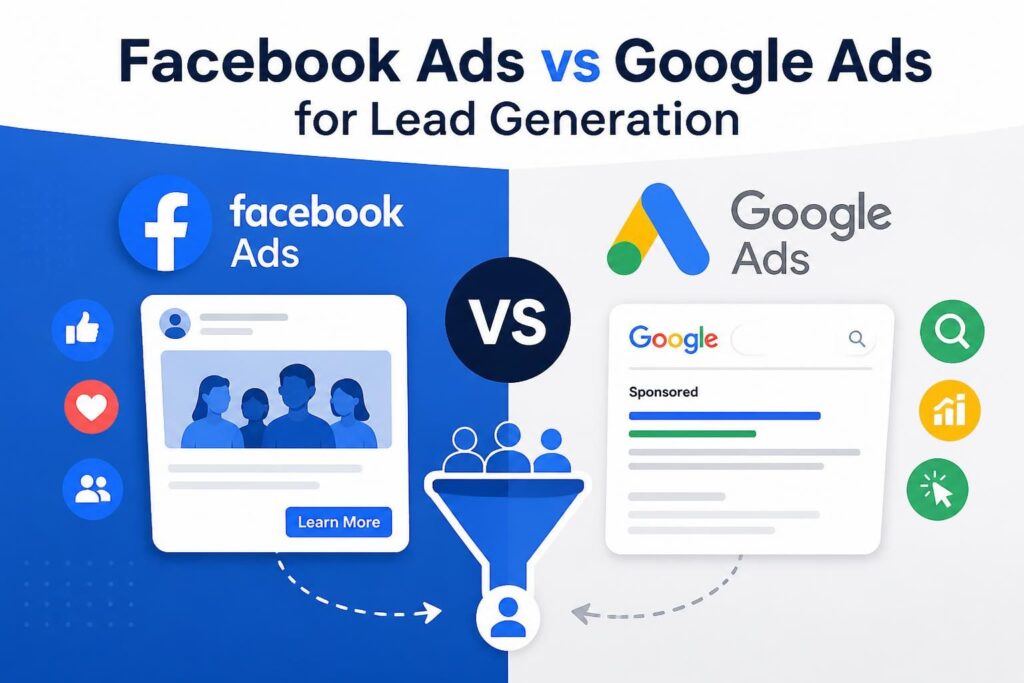




Facebook Ads and Google Ads can both generate leads, but they capture demand at different stages. Google Ads is usually strongest when people are actively searching for a product, service or solution. Facebook Ads, delivered through Meta’s advertising platform, is often better at introducing an offer to selected audiences before they begin searching.
The right platform depends on what you sell, how quickly customers make decisions, the strength of your offer and the quality of your follow-up process. Many South African businesses benefit from using both platforms, but each campaign should have a defined role rather than splitting the budget without a clear reason.
Siteweb services that support stronger lead generation
Paid advertising performs better when the rest of your online presence supports the campaign. Siteweb Online Marketing can assist with Google Ads campaign management, social media marketing, search engine optimisation, Google Business Profile optimisation and generative engine optimisation. These services can help create a more connected path from initial visibility to enquiry and eventual sale.
Facebook Ads vs Google Ads: the practical difference
Google Ads captures existing intent, while Facebook Ads creates and develops interest. A person searching Google for an electrician, accountant, software provider or industrial supplier is already expressing a need. A Facebook user may not be looking for that service at the time, but may respond when a relevant offer appears in the feed.
This distinction affects targeting, advertisements, landing pages and lead quality. A Google Search campaign begins with the phrases people type into Google. A Facebook campaign generally begins with an audience, creative concept and offer that can interrupt browsing without feeling irrelevant.
Neither approach is automatically better. The stronger option is the one that matches how customers discover and evaluate your particular service.
| Decision factor | Google Ads | Facebook Ads |
|---|---|---|
| Primary strength | Capturing active search demand | Generating awareness and interest |
| Typical targeting basis | Keywords, search intent, location and audiences | Audience characteristics, interests, engagement and first-party data |
| Common lead path | Search, advert, landing page, enquiry | Advert, lead form or landing page, follow-up |
| Creative requirement | Clear copy aligned with the search | Strong images or video supported by persuasive copy |
| Best suited to | Services people already know they need | Visual, unfamiliar or consideration-led offers |
| Main risk | Paying for irrelevant or weak-intent searches | Collecting curious leads with limited buying intent |
When Google Ads is likely to generate better leads
Google Search Ads are often the better starting point when potential customers can clearly describe their problem and are already looking for a provider. This is common for local services, professional services, urgent repairs and business-to-business products with recognisable search terminology.
For example, a business owner searching for “payroll services near me” is demonstrating more immediate intent than someone who sees a payroll advertisement while browsing Facebook. The searcher may still compare several providers, but the commercial need already exists.
Google Ads is a strong fit when:
- People actively search for the service or product.
- The business serves a defined geographic area.
- A lead has enough potential value to justify paid clicks.
- The landing page can answer the searcher’s specific question.
- The business can respond promptly to calls and form submissions.
- There is a clear distinction between valuable and irrelevant searches.
Google Ads also gives advertisers control over match types, negative keywords, location settings, devices, schedules and conversion goals. That control is useful, but it requires regular review. A campaign can attract expensive, irrelevant traffic if broad searches are accepted without checking the search terms that actually triggered the ads.
Where Google Ads can struggle
Search advertising cannot create search volume that does not exist. A new category, unfamiliar service or highly specialised solution may have very few relevant searches. Competitive industries can also make clicks costly, particularly when advertisers all target the same obvious commercial terms.
A weak landing page creates another problem. Paying for a high-intent visit does not guarantee an enquiry if the page loads slowly, lacks useful information, hides contact details or makes unsupported claims. Campaign management and landing-page quality need to be assessed together.
When Facebook Ads is likely to work better
Facebook Ads can be effective when the audience is identifiable but is not actively searching. Meta placements can introduce an offer through Facebook and Instagram using images, video, carousels, instant forms and other formats. This suits businesses that can demonstrate an outcome, present an appealing offer or educate customers about a problem they have not yet prioritised.
A home-improvement company, training provider or consumer brand may be able to generate interest through visual proof, explanations and customer-focused creative. For a longer business-to-business sale, Facebook can also support awareness and remarketing even if the final enquiry occurs through another channel.
Facebook Ads is a strong fit when:
- The offer benefits from images, demonstrations or video.
- The target customer can be described by location, interests or previous interaction.
- The service is useful but not commonly searched for by name.
- The campaign has a persuasive reason for someone to act now.
- The business can nurture leads who are not ready to buy immediately.
- Remarketing is needed to reconnect with website visitors or engaged users.
Meta lead forms can reduce friction because a user can submit details without leaving the platform. Lower friction can increase submission volume, but it may also produce casual enquiries. Qualification questions, clear offer wording and fast human follow-up help distinguish potential customers from people who submitted without serious intent.
Where Facebook Ads can struggle
Audience targeting alone cannot compensate for weak creative. People are not visiting Facebook to read an advertisement, so the message must earn attention quickly and communicate a relevant benefit without exaggeration. Creative fatigue can also reduce performance when the same audience repeatedly sees the same advertisement.
Lead quality is another concern. A low cost per lead may appear attractive while producing few appointments or sales. Facebook campaigns should be evaluated against qualified leads and revenue outcomes, not form submissions alone.
Which platform produces higher-quality leads?
Google Ads often produces stronger immediate intent because users are searching for an answer. Facebook Ads may deliver more leads at an earlier stage, particularly when the offer has broad appeal. Actual quality depends on targeting, campaign structure, landing-page clarity, qualification and follow-up.
A useful definition of lead quality should be agreed before comparing platforms. For one business, a qualified lead may be a decision-maker within the service area who needs help this month. For another, it may be a company of a certain size preparing for a purchase within six months. Without that definition, teams often confuse a cheap enquiry with a commercially valuable opportunity.
Track the progression from click to sale rather than judging only the first conversion:
- Enquiry: A person submits a form, calls or starts a message.
- Contacted lead: The business successfully reaches the person.
- Qualified lead: The need, location, budget or other criteria fit the service.
- Appointment or proposal: The prospect takes a meaningful next step.
- Customer: The lead produces revenue.
This approach may reveal that the platform with the higher cost per lead has the lower cost per customer.
How budget and cost should be compared
There is no universal answer to whether Facebook Ads or Google Ads is cheaper. Costs vary by industry, audience, location, competition, campaign objective, creative quality, bidding strategy and conversion rate. Published benchmark figures can provide context, but they should not be treated as a quote for a specific South African business.
Set an initial budget according to the economics of the sale. Begin with the average gross value of a new customer, the proportion of qualified opportunities that become customers and the amount the business can afford to acquire one. That produces a more useful ceiling than selecting an arbitrary daily budget.
The following measurements provide a clearer comparison:
- Cost per qualified lead, not merely cost per form submission.
- Lead-to-appointment rate for service businesses.
- Sales conversion rate by campaign and platform.
- Customer acquisition cost, including advertising and relevant management costs.
- Revenue or gross profit from acquired customers where reliable tracking is possible.
- Time to conversion, especially for longer sales cycles.
Businesses should also account for VAT and billing settings when planning cash flow, while confirming current tax treatment with an appropriate adviser. Platform charges, agency fees and creative production should be separated in reporting so decision-makers can see where the budget is being used.
A decision framework for South African businesses
Choose Google Ads first if customers already search for the service, the need is relatively urgent and a search can be matched to a dedicated landing page. Choose Facebook Ads first if awareness must be created, the product is visually demonstrable or the offer can be targeted to a recognisable audience.
Before launching either platform, answer these questions:
- What event counts as a qualified lead?
- Which provinces, cities or service areas can the business serve profitably?
- Does the campaign need phone calls, forms, messages, bookings or purchases?
- How quickly can the sales team respond?
- What objections prevent prospects from enquiring?
- Can website and customer relationship management data show which leads become customers?
- Is there enough creative material for Facebook or enough relevant search demand for Google?
Location settings deserve particular attention. A company serving Gauteng should not automatically pay for clicks or leads from areas it cannot support. Search presence can also be strengthened through an accurate Google Business Profile, especially where customers look for nearby providers and local credibility.
Businesses collecting names, email addresses, phone numbers or other personal information should handle that data responsibly and align forms, consent wording, storage and follow-up practices with applicable South African privacy requirements. Advertising platforms provide tools, but the advertiser remains responsible for its own data practices.
Why using both platforms can produce a stronger result
Facebook and Google do not have to compete for the same job. Facebook can introduce the business and build familiarity, while Google captures people who later search for the brand, service or solution. Remarketing can reconnect with visitors who viewed a page but did not enquire.
A combined campaign could work like this:
- Facebook or Instagram content introduces a problem and shows the desired outcome.
- Interested people visit a focused service page or engage with the content.
- Remarketing keeps the business visible during the consideration period.
- Google Search Ads appear when prospects actively research providers.
- Conversion tracking and sales records identify which sequence produces qualified customers.
Attribution will not always show every interaction perfectly. People switch devices, reject tracking permissions, call from another phone or return later through an organic search. Treat platform reports as decision tools rather than flawless records, and compare them with call logs, form data and confirmed sales.
Common mistakes that waste advertising budget
Sending every advert to the home page
A home page usually serves several audiences and services. A focused landing page should continue the promise made in the advert, explain the relevant service, answer objections and provide a clear next step.
Optimising for the easiest conversion
Advertising systems optimise towards the signals they receive. If every form submission is treated equally, the platform cannot distinguish a suitable prospect from spam or an unserviceable enquiry. Feeding reliable qualified-lead or sales outcomes back into the measurement process can improve decision-making.
Changing campaigns too frequently
Reactive changes make it difficult to understand what caused an improvement or decline. Monitor spend and obvious problems closely, but assess changes against sufficient data and the normal length of the sales cycle.
Ignoring missed calls and slow follow-up
The advertising platform is often blamed for leads that were contacted too late or not contacted at all. Record response times, call outcomes and reasons leads are rejected. This reveals whether the problem sits with targeting, the offer or the sales process.
Comparing clicks instead of business outcomes
Click-through rate and cost per click are useful diagnostic measures, not the final objective. A campaign with expensive clicks can still be profitable if those visitors become valuable customers. A high volume of cheap clicks can consume budget without producing revenue.
How to test Facebook Ads against Google Ads fairly
A useful test needs consistent definitions and a realistic time window. Avoid expecting both platforms to produce identical lead behaviour because one may capture immediate demand while the other develops it.
- Define the offer and audience. Specify the service, service area and qualifying criteria.
- Set up conversion measurement. Track forms, calls and other meaningful actions, then connect them to qualified outcomes where possible.
- Create platform-appropriate campaigns. Use intent-led copy for Google and attention-earning creative for Facebook.
- Use relevant landing pages. Keep the message consistent from advertisement to enquiry.
- Record lead outcomes. Note contactability, qualification, appointments, proposals and sales.
- Compare cost per qualified result. Consider the time required for leads to convert before making a decision.
- Refine the stronger combinations. Reallocate budget according to evidence rather than personal preference.
If the budget is too small to test several audiences, keywords and offers at once, start with the channel closest to existing demand. A tightly defined campaign usually provides more useful evidence than spreading a limited budget across numerous campaign types.
Questions business owners ask before choosing a platform
Is Google Ads better than Facebook Ads for lead generation?
Google Ads is generally better for capturing people actively searching for a known service. Facebook Ads can be better for creating interest, demonstrating an offer and reaching potential customers earlier. The best choice depends on search demand, audience definition, sales value and follow-up capability.
Which platform should a small business start with?
A small business should begin where customer intent is clearest. If people already search for the service, a focused Google Search campaign may be the practical first test. If the offer relies on visual appeal or customers are unlikely to search for it, Facebook may provide a better entry point.
Can Facebook Ads work for business-to-business leads?
Yes, particularly for awareness, educational offers and remarketing. Results depend on whether the intended decision-makers can be reached and whether the campaign has a credible reason to engage. Complex B2B sales usually need qualification and lead nurturing rather than an immediate sales expectation.
How long should an advertising test run?
There is no single testing period for every campaign. The required time depends on budget, conversion volume and sales-cycle length. A campaign should run long enough to produce meaningful qualified-lead data, unless tracking errors, irrelevant traffic or other clear problems require immediate correction.
Do paid ads help SEO rankings?
Paying for Google or Facebook Ads does not directly buy higher organic rankings. Paid media and SEO can still support the same customer journey: advertising produces immediate visibility and campaign data, while SEO builds unpaid search visibility over time.
Choose the channel according to demand, not popularity
The Facebook Ads vs Google Ads decision becomes easier once the business defines where demand begins. Google is often the stronger option for active, high-intent searches. Facebook is well suited to building awareness, presenting visual offers and nurturing audiences before they search. Using both can cover more of the buying journey, provided each platform has a specific purpose.
Siteweb Online Marketing can help assess your offer, search demand, audience, landing pages and conversion tracking before advertising budget is committed. If you want a campaign focused on qualified enquiries rather than surface-level metrics, contact Siteweb to discuss your lead-generation goals.
Authoritative platform resources
- Google Ads Help for current guidance on campaign settings, targeting and conversion measurement.
- Meta Business Help Centre for current information about Facebook and Instagram advertising tools.