
Website design trends businesses should know about
August 19, 2026
Why is my Google Business Profile not ranking
August 24, 2026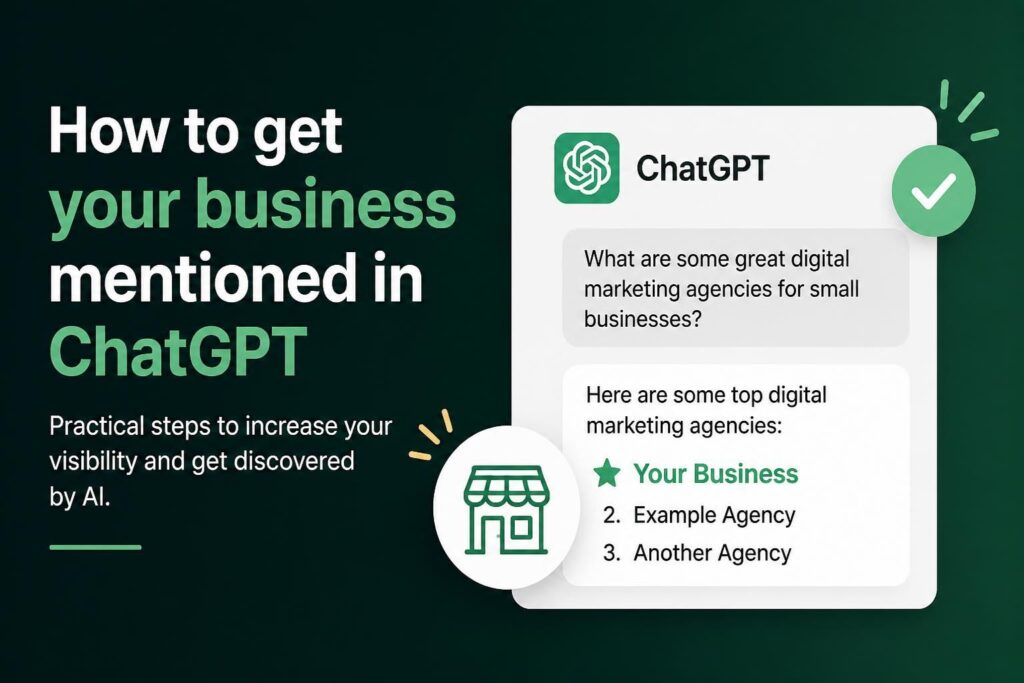




There is no form you can submit to guarantee that ChatGPT will recommend your business. A company is more likely to be mentioned when its website is accessible, its services are clearly described, and independent sources consistently confirm what the business does. The aim is not to manipulate an AI model. It is to create reliable, easy-to-understand information that search engines and AI-powered discovery tools can find, interpret and cite.
For South African businesses, this means improving the same digital signals that help customers verify a company: a technically sound website, focused service pages, accurate business details, relevant local information, credible mentions and useful content. ChatGPT visibility is best treated as part of a broader search and brand-awareness strategy rather than a separate shortcut.
Siteweb services that support online brand visibility
Different channels contribute to how often a business is discovered, researched and discussed online. Siteweb Online Marketing can assist with:
- Google Business Profile optimisation for clearer local business information and stronger map visibility.
- Google Ads management to reach people actively searching for relevant products or services.
- Search engine optimisation to improve website accessibility, relevance and organic search visibility.
- Generative engine optimisation to make important business information easier for AI-powered systems to retrieve and understand.
- Social media marketing that builds awareness and distributes useful brand content.
How ChatGPT decides which businesses to mention
ChatGPT does not maintain a public directory in which business owners can reserve a recommendation. Depending on the feature being used and the question being asked, an answer may draw on information learned during model development, current web search results, cited web pages or data supplied during the conversation. The exact sources and results can differ between prompts and can change over time.
A request such as “recommend an accountant in Cape Town” is different from “which accounting firms have published guidance about VAT registration in South Africa?” The first requires evidence of location, services and reputation. The second favours pages that answer a specific question clearly and can be found on the web. A business needs content and corroborating signals that match the types of questions prospective customers ask.
Being indexed by a conventional search engine does not guarantee a ChatGPT citation, and a ChatGPT mention does not necessarily mean the company ranks first on Google. These systems overlap, but they are not identical. The practical goal is to make your company a credible candidate whenever a relevant answer requires a business, source or example.
Build a clear, verifiable business identity
AI systems struggle with vague or inconsistent entities. If a company uses one name on its website, another on social media and an outdated address in business directories, it becomes harder to connect those records confidently. Start by deciding how the business should be represented and use that identity consistently.
- Use the same official business or trading name across prominent profiles.
- Publish an accurate phone number, email address and service area.
- Describe the main services in specific language rather than broad slogans.
- Keep addresses, opening hours and profile links current.
- Create a detailed About page that identifies the company, market served and field of work.
- Make contact and customer-support information easy to locate.
Consistency does not mean copying an identical promotional paragraph onto every platform. It means that the underlying facts agree. A customer, search engine or AI system should be able to determine that the website, business profile and relevant external listings refer to the same organisation.
Create pages that answer the questions customers actually ask
A five-page brochure website provides limited evidence about a company’s expertise. Stronger sites contain focused pages explaining individual services, customer problems, processes, limitations and decision criteria. Each page should have a defined purpose rather than attempting to rank one generic page for every possible query.
For example, a solar installer could publish separate resources covering inverter sizing, battery capacity, backup limitations, installation assessments and maintenance. A legal practice might explain which matters it handles, the documents required for an initial consultation and when specialist advice is necessary. These pages give retrieval systems precise passages that can support an answer.
Write quotable answers without sounding mechanical
Place a short, direct answer near the start of an important section, then provide the qualifications and detail a reader needs. Define technical terms when they first appear. Use descriptive headings, meaningful examples and complete statements that still make sense if extracted from the page.
Avoid producing dozens of shallow articles that merely reword common advice. Original checklists, South African examples, process explanations, comparison criteria and answers based on genuine service knowledge are more useful. Content should also identify boundaries. If a price depends on scope, explain the factors rather than publishing a fabricated average. If professional assessment is required, say so.
Make the website accessible to search and AI crawlers
Useful content cannot be considered if a crawler cannot retrieve it. Review the website’s robots.txt directives, page-level robots instructions, canonical tags, redirects and server responses. Important information should be present in the rendered page and should not depend entirely on interactions that a crawler may not complete.
OpenAI documents separate user agents for different purposes. OAI-SearchBot is associated with surfacing websites in ChatGPT search, while GPTBot relates to potential model training. These controls are independent, so a business can make informed choices about search discovery and training access. ChatGPT-User may also access a page in response to a user action. The current definitions and technical guidance should be checked in OpenAI’s official crawler documentation before changing robots.txt.
Do not block a crawler simply because its name is unfamiliar, but do not open private or low-value sections indiscriminately either. Protect account areas, staging sites, internal search results and confidential content. After a technical change, test the live response instead of assuming the configuration works.
Technical checks worth completing
- Confirm that important pages return a successful HTTP status and are not marked noindex.
- Use one preferred URL for each page and apply canonical tags correctly.
- Maintain an XML sitemap containing current, indexable URLs.
- Fix broken internal links, redirect chains and accidental soft-error pages.
- Use descriptive page titles and headings that match the visible content.
- Ensure the mobile page contains the same core business information as the desktop version.
- Improve load performance without hiding essential text behind scripts.
- Monitor server logs where possible to understand legitimate crawler access.
Submitting important URLs through recognised webmaster platforms can support discovery by their respective search engines. It does not purchase or guarantee an AI mention, but it helps remove avoidable indexing problems.
Use structured data to clarify facts, not manufacture them
Schema markup gives machines a consistent way to identify an organisation, service, article, address or frequently asked question. Appropriate markup can connect a business name with its official website, logo, contact information and public profiles. Service markup can describe offerings, while Article markup identifies the page’s headline, author or publisher and publication details.
Structured data must match information visible on the page. Adding invented ratings, locations, awards or credentials is misleading and may conflict with search-engine policies. Schema also does not compel ChatGPT or any search engine to cite the page. Its value lies in reducing ambiguity about real information.
Earn independent mentions that support your claims
A business claiming to be an expert on its own website is expected. Independent evidence is more persuasive. Relevant mentions may come from industry bodies, professional directories, suppliers, event organisers, local publications, trade media, podcasts, business partners or clients discussing completed work. Quality and relevance matter more than placing the company name on hundreds of unrelated directory pages.
Good digital public relations starts with something worth referencing. This might be an original industry survey, a practical calculator, a well-supported local guide, expert commentary on a current issue or a case study containing measurable information that the client has approved for publication. Outreach should direct the resource to journalists, associations and publishers whose audiences genuinely benefit from it.
Do not buy bulk links or arrange fake reviews to create apparent popularity. Such tactics weaken trust and can expose the business to platform penalties. A smaller number of accurate, editorially relevant mentions is a stronger foundation than a large footprint of copied profiles.
Strengthen local signals for South African searches
Many commercial prompts have implicit local intent. A person asking for a plumber, marketing agency or attorney usually needs a provider serving a particular area, even if the first prompt omits the location. Publish the towns, cities or provinces genuinely served, but avoid creating near-identical pages for every suburb.
A complete Google Business Profile supports customer discovery in Google products and provides a prominent source of verified business information. Select accurate categories, keep contact details and hours current, add relevant services, and respond professionally to reviews. Reviews should be requested from real customers without dictating positive wording or offering incentives that breach platform rules.
Local relevance can also be demonstrated through useful content. Explain service availability, delivery areas, consultation options and regional constraints. South African terminology, currencies and regulatory references should be used where they genuinely apply. If the company serves clients nationally or remotely, state how that process works rather than implying a physical office in every location.
Develop topical authority around a defined market
Businesses are easier to understand when their websites show a coherent field of expertise. Random posts chosen only because a keyword appears popular can dilute that picture. Organise content around the company’s actual services, the problems those services solve and the decisions customers make before purchasing.
A useful topic cluster normally includes a strong service page supported by guides, comparisons, case studies, common-problem articles and process explanations. Internal links should show the relationship between these resources. For example, an educational article about AI citations can naturally direct a reader to a detailed generative engine optimisation service, while a discussion of organic discovery can point to professional SEO assistance.
Update pages when facts, platforms or service details change. A date alone does not make content current; the information itself must be reviewed. Remove unsupported claims, repair old links and consolidate pages that compete with one another without offering distinct value.
A practical process for improving ChatGPT visibility
- Record your baseline. Test a documented set of realistic prompts in the markets you serve. Note whether the company appears, which competitors are mentioned, what sources are cited and whether the answers are current. Results can vary, so avoid treating one query as definitive.
- Audit business information. Compare the website, Google Business Profile, social accounts and major relevant directories. Correct conflicting names, addresses, service descriptions and contact details.
- Check crawlability and indexing. Review robots.txt, crawler permissions, status codes, canonicals, sitemaps and noindex directives. Confirm that the pages you want discovered are publicly accessible.
- Map customer questions to pages. Identify informational, comparison and purchase-stage searches. Improve an existing page or create a focused resource for each meaningful gap.
- Add supporting evidence. Include accurate examples, named processes, author information, source references and approved case studies where available.
- Improve entity connections. Link to official social profiles, use suitable structured data and ensure trusted external profiles link back to the correct website.
- Promote valuable resources. Share content with customers, partners, publishers and relevant communities. Promotion should earn genuine readership and references rather than artificial link volume.
- Measure outcomes. Monitor organic visibility, referral traffic, branded searches, assisted enquiries and cited pages. Ask new leads how they found the company, including whether an AI assistant influenced their research.
Common mistakes that reduce the chance of being cited
The most frequent mistake is treating generative engine optimisation as a hidden technical trick. Machine-readable markup and crawler access help, but they cannot compensate for a weak offer, thin content or an absence of independent evidence.
- Publishing large volumes of generic, lightly edited content.
- Using vague descriptions such as “leading solutions provider” without stating what is provided.
- Creating fake author biographies, case studies, addresses or customer reviews.
- Blocking useful crawlers unintentionally through a security plugin or robots rule.
- Relying on social media while neglecting a permanent, indexable website.
- Producing location pages with duplicated text and no location-specific value.
- Changing business details on one platform but leaving older records untouched.
- Measuring success only by asking ChatGPT the same prompt repeatedly.
Another mistake is expecting immediate, stable results. Search indexes, external citations and AI retrieval systems change at different speeds. Even a well-established company may appear for one prompt and not another because wording, location, freshness and source availability affect the response.
How to measure whether the work is producing business value
There is no single universal “ChatGPT ranking” report. Measurement should combine prompt observations with website and lead data. Track a fixed set of high-value prompts periodically, but also examine whether the pages being cited or discovered generate qualified visits and enquiries.
Useful indicators include growth in branded searches, improved visibility for service-related queries, referral visits from AI platforms where analytics provide that information, links and mentions from relevant websites, engagement with expert resources, and leads that name ChatGPT or another AI assistant as part of their research. Record prompt wording, date, account conditions and cited sources so comparisons have context.
The commercial objective is not merely to make a brand name appear in an answer. It is to be represented accurately, in a relevant context, and to give the prospective customer a credible next step.
Questions business owners ask about ChatGPT mentions
Can I submit my business directly to ChatGPT?
There is no general business-listing submission that guarantees recommendations in ChatGPT. Businesses can improve discoverability by publishing accessible, accurate information, maintaining consistent profiles, permitting relevant crawler access and earning reputable third-party mentions.
Do I need to allow GPTBot to appear in ChatGPT search?
OpenAI documents GPTBot and OAI-SearchBot as separate controls. GPTBot relates to potential model training, while OAI-SearchBot supports ChatGPT search visibility. Review the current official documentation and choose permissions that suit your organisation’s content and privacy policies.
Will SEO help my company get mentioned?
Sound SEO improves crawlability, indexability, page relevance and website authority, all of which can support discovery. It cannot guarantee that ChatGPT will select a business. The strongest approach combines technical SEO, useful content, consistent entity information and credible external references.
How long does generative engine optimisation take?
There is no fixed timeline. Technical corrections may be processed sooner than reputation-building, editorial mentions or the development of a substantial content library. Progress depends on the site’s current condition, competition, crawl frequency and the quality of new evidence published about the business.
Can paid advertising buy a ChatGPT recommendation?
Advertising can increase visibility and demand through the platform on which it is purchased, but it should not be confused with an independent organic citation. Evaluate paid media according to its own placement, targeting and reporting terms rather than assuming it will influence unpaid AI answers.
Build a brand that AI systems can verify
Getting your business mentioned in ChatGPT starts with being clear enough to understand and credible enough to reference. Publish specific service information, answer real customer questions, keep business details consistent, resolve technical access problems and earn relevant mentions beyond your own website. These actions also improve the experience of people researching the company through conventional search, maps and social platforms.
Siteweb Online Marketing can assess how your website, search presence and external brand signals work together, then identify practical opportunities to improve organic discovery and lead generation. If you want a structured plan for SEO and generative search visibility, contact Siteweb Online Marketing to discuss your current online presence and business goals.
Authoritative resources
- OpenAI guidance about ChatGPT search
- OpenAI crawler and robots.txt documentation
- Bing Webmaster Tools
- Schema.org Organization structured data vocabulary