
How to rank a service business in multiple towns
November 2, 2026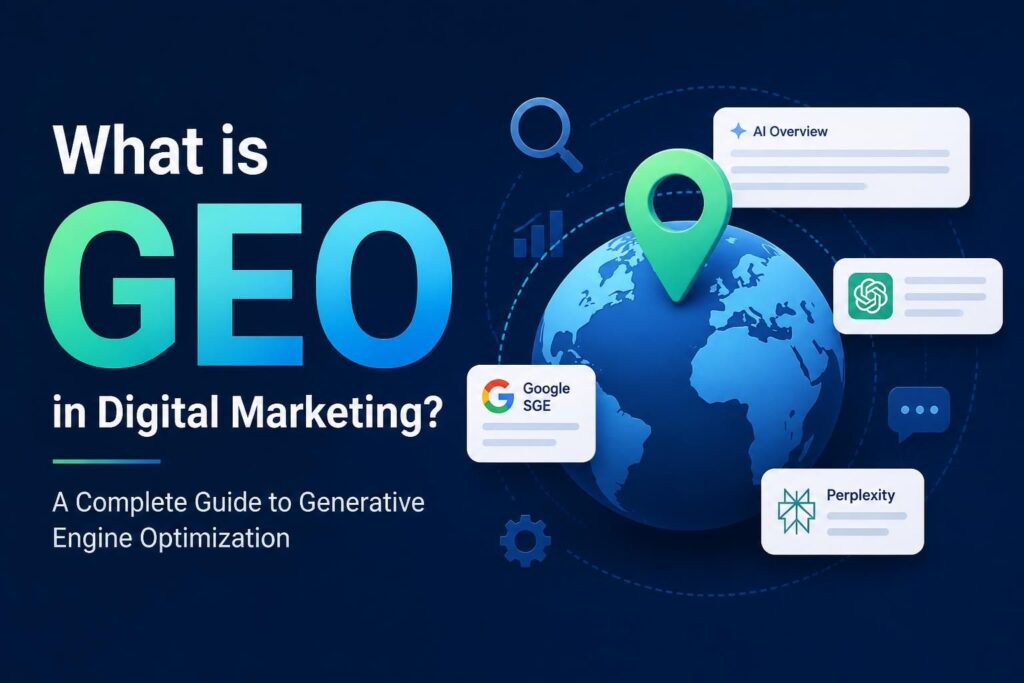




GEO in digital marketing usually means generative engine optimisation: the practice of making a business and its content easier for AI-powered search and answer systems to understand, trust, cite and recommend. These systems include Google AI Overviews, Gemini, ChatGPT, Microsoft Copilot and Perplexity. GEO does not replace search engine optimisation. It extends established SEO, content and brand-building practices into search experiences that generate a direct answer rather than displaying only a list of links.
The abbreviation can also mean geographic targeting in advertising, so context matters. This guide focuses on generative engine optimisation and what it means for South African business owners who want stronger brand visibility, qualified website traffic and lead generation. Geographic targeting is covered briefly later to clarify the difference.
Build visibility across search, AI and social platforms
GEO performs best when it is supported by a credible presence across the channels customers use to research businesses. Siteweb Online Marketing can help connect your generative search strategy with these related services:
- Google Business Profile optimisation for stronger local business information and map visibility
- Google Ads management for targeted paid search campaigns and measurable lead generation
- search engine optimisation services for organic rankings, technical quality and useful content
- generative engine optimisation for visibility within AI-generated answers and recommendations
- social media marketing that supports brand recognition, audience engagement and content distribution
How generative engine optimisation works
A conventional search engine normally retrieves and ranks pages for a query. A generative search system may retrieve information from multiple sources, interpret it and produce a combined answer. Depending on the platform and query, that answer may include citations, links, product suggestions, local businesses or a short list of recommended options.
GEO improves the probability that a business will be represented accurately in those results. It does this by strengthening the information available about the business, publishing clear answers to relevant customer questions and making claims easy to verify. There is no method that guarantees inclusion. AI systems choose sources according to their own retrieval methods, indexes, quality signals and response policies.
The work happens across three connected areas:
- Entity clarity: making the business name, services, location, contact details and areas of expertise consistent across the website and credible third-party platforms.
- Content quality: publishing original, specific and well-structured information that answers genuine customer questions.
- Technical accessibility: ensuring search engines can crawl, render, index and interpret the relevant pages.
Brand authority also develops away from the website. Independent mentions, customer reviews, professional profiles, media coverage and relevant directory listings can help systems connect a brand with a service or subject. These signals must be earned and accurate; creating large numbers of weak listings or manufactured mentions is not a dependable GEO strategy.
GEO and SEO solve different parts of the visibility problem
SEO aims to improve a website’s visibility in conventional organic search results. GEO aims to improve how information about a brand is retrieved and represented in generated answers. The two disciplines overlap heavily because an AI system still needs accessible, understandable and credible source material.
A useful comparison is:
- SEO outcome: a page ranks for a relevant search and earns a click.
- GEO outcome: a brand, page, fact or recommendation appears within an AI-generated response, potentially with a citation or link.
- Shared foundation: crawlable pages, clear site structure, accurate information, topical relevance, authority and a satisfactory user experience.
Google’s guidance on AI features and website content states that standard SEO practices remain relevant and that no special AI file or unique schema type is required for inclusion. Structured data can help search systems understand page content, but it must match information that visitors can see. Adding unsupported claims to schema will not make a weak page authoritative.
What an AI answer engine needs to understand about a business
A business website often makes sense to its owner but leaves important questions unanswered for a search system. A generic services page may say that a company provides high-quality solutions without clearly defining the service, customer, location, process or evidence behind the claim.
For stronger machine and human understanding, a website should make the following information clear:
- The official business name and consistent contact details
- The products or services provided
- The customers, industries or problems those services address
- The geographic areas served, where location is relevant
- How the service works and what is included
- Who is responsible for the content or professional advice
- Evidence supporting factual, technical or performance claims
- Policies, limitations, costs or cost factors that influence a buying decision
Clear information is especially valuable in South Africa, where language, city, province, service area and market conditions can change the relevance of an answer. A Johannesburg-based service provider, a national ecommerce retailer and a Cape Town tourism business should not publish identical content. Each needs pages grounded in the questions and circumstances of its own customers.
A practical GEO process for South African businesses
1. Establish a reliable business entity
Start by checking how the business is described on its website, Google Business Profile, social profiles and important industry platforms. Names, telephone numbers, URLs and addresses should not conflict. Service descriptions should use language customers recognise rather than internal terminology.
Local businesses should complete relevant profile fields, select accurate categories and keep opening hours current. Reviews can provide useful evidence of customer experience, but they should be acquired honestly and answered professionally. Businesses must not offer misleading incentives or post reviews on behalf of customers.
2. Map real questions to suitable pages
Generic blog production is not a GEO plan. Identify the questions customers ask before contacting the business, while comparing providers and after purchasing. Search query data, sales conversations, support emails, Google Business Profile interactions and website search records can reveal useful topics.
Decide whether each question belongs on a core service page, comparison page, guide, case study or FAQ. A service page should explain the commercial offering. A guide can address a broader problem. Combining every keyword and question on one page often produces unfocused content.
3. Publish information that can be verified
Generated answers favour information that can be interpreted confidently. Use precise definitions, named processes, relevant examples and direct answers. Link factual claims to authoritative sources where support is needed. If a result varies by budget, market or competition, explain the variables instead of promising a universal outcome.
First-party information can distinguish a business from pages that simply repeat common advice. Suitable material includes an original process, anonymised project observations, a detailed service methodology, product specifications, expert commentary and case studies with properly supported results. Never invent customers, quotations or performance figures.
4. Improve technical access and page structure
Search engines must be able to discover and process the content. Important checks include indexability, internal linking, canonical tags, mobile usability, page speed, rendered content and XML sitemap coverage. Headings should describe the material beneath them, while title tags and meta descriptions should accurately represent each page.
Structured data may identify an organisation, local business, article, product, service or FAQ where the visible content supports that type. It is an explanatory layer, not a substitute for the page itself. Technical teams should also check that important content is not hidden behind scripts, forms or interactions that crawlers cannot reliably access.
5. Strengthen off-site corroboration
A business describing itself as an expert is weaker evidence than independent sources associating that business with the subject. Relevant industry listings, supplier pages, association memberships, interviews and editorial mentions may reinforce brand understanding. The goal is not to place the same promotional paragraph on dozens of websites. It is to build a genuine, consistent footprint in places customers and search systems can trust.
6. Measure outcomes beyond rankings
AI visibility is not always reported as cleanly as conventional keyword rankings. Measurement should therefore combine several signals:
- Referral sessions from AI and answer platforms where the source is available
- Conversions and assisted conversions from those visits
- Branded search growth
- Citations or brand mentions for a controlled set of representative prompts
- Organic impressions and clicks for related questions
- Lead quality and the questions prospects ask before contacting the business
Prompt tracking can show patterns, but individual answers may change according to platform, model version, location, personalisation and wording. Treat a prompt report as a sample rather than a fixed ranking position.
Content formats that tend to support generative search visibility
No single format guarantees an AI citation. The best format depends on the question. A concise definition can answer an introductory query, while a buyer comparing providers may need criteria, limitations and pricing factors.
Useful formats include:
- Detailed service pages that explain scope, process and suitability
- Comparison pages that state meaningful differences without misrepresenting competitors
- Step-by-step guides written by someone familiar with the process
- Case studies containing context, actions and supported outcomes
- Glossaries for specialist terminology used by customers
- Research or analysis based on legitimate first-party data
- Frequently asked questions attached to relevant service content
Short, direct passages help systems extract an answer, but the surrounding detail establishes context. A page made entirely from disconnected definitions and bullet points may be easy to scan yet too shallow to help a customer make a decision.
Common GEO mistakes that weaken trust
The most frequent mistake is treating GEO as a shortcut for producing large volumes of AI-written content. Volume does not create authority. Pages that repeat information already available elsewhere, include factual errors or fail to address a customer’s circumstances add little value.
Other avoidable problems include:
- Publishing statistics without a traceable source or date
- Creating unsupported claims about being the best, largest or leading provider
- Using schema markup for reviews, services or locations that are not visible on the page
- Producing near-identical pages for every South African town
- Blocking important resources from crawling without checking the consequences
- Changing business descriptions across platforms to target more keywords
- Tracking brand mentions without measuring enquiries, sales or lead quality
Another mistake is writing only for extraction. A generated answer may introduce a prospect to the brand, but the website still needs to persuade that person to take the next step. Clear service information, trustworthy evidence, usable navigation and a straightforward contact route remain necessary.
GEO can also mean geographic targeting
In advertising discussions, GEO may refer to geographic targeting or geotargeting. This is the practice of showing ads or tailoring campaigns according to a person’s country, province, city, radius or another location signal. A South African business might use it to limit paid search ads to areas it can serve.
Geotargeting and generative engine optimisation are separate concepts. One controls or influences where marketing messages are delivered; the other improves how content and brands may appear in generated answers. A campaign brief should spell out the intended meaning to avoid confusion.
How GEO supports lead generation
Generative search often appears early in the buying journey, when a person is defining a problem, comparing approaches or building a shortlist. A business that is accurately represented at this stage can earn recognition before the prospect visits individual websites.
Visibility alone is not a lead. The cited or recommended page should offer a logical next action, such as reviewing a service, requesting an assessment or contacting the business. Calls to action should match the reader’s readiness. Someone asking what GEO means may want an educational review, while a marketing manager comparing providers may be ready to discuss implementation.
GEO also exposes weaknesses in the broader marketing system. If a business has unclear services, inconsistent local information or thin website content, optimisation for generative search will be limited. Fixing those weaknesses can improve conventional search performance and conversion quality at the same time.
Questions to ask a GEO service provider
GEO is a developing discipline, so businesses should be cautious of guaranteed citations or fixed AI rankings. Before appointing a provider, ask:
- How will GEO integrate with our existing SEO, content and digital PR work?
- Which technical, on-page and off-site issues will be assessed?
- How will factual accuracy and source quality be checked?
- What metrics will be used, and what are their limitations?
- How will content reflect our actual expertise rather than generic information?
- Who approves claims, case studies and business details before publication?
- How will success connect to enquiries, qualified leads or revenue?
A credible proposal should explain the work, dependencies and measurement approach. It should not suggest that hidden tags, mass-produced pages or a special file can force an AI platform to recommend a business.
Questions business owners ask about GEO
Can GEO guarantee that ChatGPT or Google will recommend my business?
No. Businesses cannot control which sources an AI platform retrieves, cites or recommends. GEO improves clarity, relevance and credibility, which may increase the chance of visibility, but guarantees should be treated with caution.
Do I need GEO if my website already ranks well?
Strong SEO gives a business a valuable foundation, but search behaviour is expanding beyond traditional result pages. GEO can help ensure that business information is structured, supported and suitable for generated answers. It should complement successful SEO rather than replace it.
How long does generative engine optimisation take?
There is no universal timeline. Technical corrections may be implemented quickly, while publishing expert content, earning third-party recognition and strengthening a brand entity can take longer. Timing also depends on crawling, indexing and how frequently an AI platform refreshes its sources.
Is special schema required for GEO?
No special GEO schema exists. Use recognised Schema.org types that accurately describe visible content, such as Organization, LocalBusiness, Service, Article or Product. Correct markup can improve understanding, but it does not guarantee rankings or citations.
Can a small South African business compete in AI search?
Yes, particularly for focused services, industries and locations where the business can provide specific expertise. A smaller company may not have the broad authority of a national brand, but accurate local information, useful specialist content and credible customer evidence can make it relevant to narrower queries.
Prepare your business for search that answers questions directly
GEO in digital marketing is best approached as a disciplined extension of SEO, content strategy, brand authority and technical website quality. The objective is not to manipulate an AI model. It is to make accurate information about the business easy to find, interpret, verify and connect to the questions potential customers ask.
Siteweb Online Marketing helps South African businesses assess how they appear across search and generative platforms, identify content gaps and build a practical route from visibility to qualified enquiries. If your website is not being cited, your brand information is inconsistent or you need a clearer lead-generation strategy, contact Siteweb Online Marketing to discuss the next steps.
Sources
- Google Search Central: AI features and your website
- Generative Engine Optimization research paper on arXiv
- Schema.org structured data vocabulary