
How to improve lead quality from Facebook Ads
October 26, 2026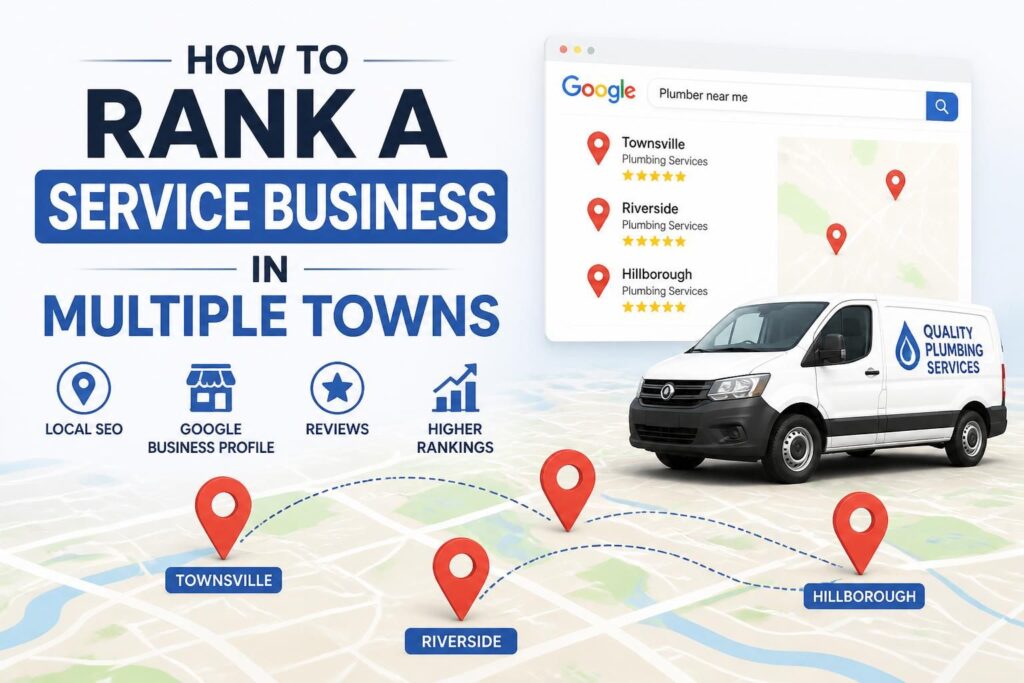





A service business can rank in multiple towns without opening an office in every location, but the strategy must reflect how Google evaluates local relevance. Strong results usually come from combining a compliant Google Business Profile, well-built town or service-area pages, consistent business information, local proof and a website with enough authority to compete beyond its home base.
The main challenge is that organic rankings and Google Maps rankings work differently. A website can rank for searches in several towns, while a Google Business Profile may remain strongest near the verified business location. The practical approach is to strengthen both channels without creating fake offices, duplicate profiles or thin location pages.
Siteweb services that support multi-location visibility
Siteweb Online Marketing can help service businesses build a broader search presence through the following services:
- Google Business Profile optimisation for stronger local relevance and accurate business information
- Google Ads campaign management for immediate, measurable visibility in selected towns
- search engine optimisation services that strengthen service pages, location pages and website authority
- generative engine optimisation to make business information clearer to AI-assisted search platforms
- social media marketing that supports brand awareness, local engagement and customer trust
What ranking in multiple towns actually means
There are several places where a business may appear when someone searches for a service in a town. These include the local map results, standard organic listings, paid advertisements and AI-generated search summaries. A business may perform well in one area of the results while remaining less visible in another.
For example, a plumbing company based in Pretoria could have a Google Business Profile that performs strongly near its verified address. Its website may also rank organically for relevant searches in Centurion, Midrand and nearby service areas if it contains useful pages for those markets. The company should not expect its map listing to hold the same position at every point across Gauteng because the searcher’s location and the distance to the business affect local results.
Google describes the main local ranking considerations as relevance, distance and prominence. Relevance concerns how well the business matches the search. Distance considers the relationship between the search location and the business. Prominence reflects how well known and trusted the business appears, based on factors that can include links, reviews and information available across the web.
Start with a realistic service-area plan
Trying to target every town in a province at once often creates weak pages and unfocused campaigns. Start by identifying the locations that the business can serve reliably and profitably. The fact that a team is technically able to travel to a town does not always make that town commercially sensible.
Evaluate each proposed area using practical criteria:
- Whether customers in the town regularly need the service
- Travel time, fuel costs and call-out limitations
- The average value and likely margin of work in that area
- Existing customers, completed projects or referrals in the town
- Local competition and the quality of pages already ranking
- The capacity to answer enquiries and complete work within a reasonable time
- Whether the business offers the same services in every target area
This process normally produces a priority list rather than a long collection of place names. A focused campaign for five commercially valuable towns is more useful than fifty near-identical pages that offer little evidence of genuine local service.
Use Google Business Profiles without breaching the rules
A service-area business may use a Google Business Profile even if customers do not visit its premises. If the business does not serve customers at the address, the address should generally be hidden and the relevant service area can be specified. The profile should represent the real business and use accurate categories, contact details, opening hours and services.
A service area entered in a profile does not guarantee rankings throughout that area. It tells customers where the business operates, but it does not remove the effect of distance. Businesses based far from a searcher may struggle to enter the map results even when the searched town appears in their stated service area.
Only create additional profiles for genuine locations
A second Google Business Profile should represent a legitimate business location that meets Google’s eligibility requirements. A virtual office, rented mailbox or address used only to influence rankings is not a sound basis for another profile. Creating multiple listings at private homes or borrowed addresses can lead to suspensions, merged listings and lost reviews.
If a company has separate, staffed operating locations that genuinely serve customers and qualify under Google’s rules, each profile should use accurate details for that location. The website should also provide clear information about the corresponding branch rather than presenting every address as interchangeable.
Complete the profile before chasing more towns
The primary profile needs a solid foundation. Select the most accurate primary category, add relevant secondary categories, describe the services clearly and keep hours current. Upload authentic photos that help customers understand the business, its work and its service process. Avoid inserting towns, services or promotional claims into the business name unless they form part of the real-world name used consistently by the company.
Reviews can strengthen trust and provide useful context about the work performed. Ask genuine customers for honest feedback after completing a service. Do not purchase reviews, reward only positive comments or ask staff to post as customers. A natural review profile is safer and more persuasive than a sudden stream of vague five-star ratings.
Create useful town pages rather than doorway pages
A town page should help a customer decide whether the business can solve a specific problem in that location. Changing only the town name on a copied template produces little value and can result in a collection of pages competing with one another. Search engines may ignore such pages if they appear designed solely to capture variations of the same query.
Each priority town needs enough distinct information to justify a separate URL. A useful page may include:
- The services available in that town
- Neighbourhoods or nearby areas served, where genuinely relevant
- Typical service constraints, response arrangements or booking requirements
- Examples of completed work in the area, when the business has verifiable examples
- Customer comments connected to work performed there, with permission where required
- Locally relevant questions about access, travel, property types or service delivery
- A clear route for requesting a quotation or booking an assessment
Local detail must be truthful. Do not claim to have an office, team or customer base in a town unless that statement can be supported. A company can state that it serves an area from another location, which is both accurate and useful to customers.
Give every location page a distinct search purpose
Map the main service and town combinations before creating pages. If a business offers one core service, a page such as solar panel cleaning in Stellenbosch may cover the relevant variations naturally. It usually does not need separate pages for every minor wording change.
A company with substantially different services may need a broader structure. A parent town page can explain the local offering and link to detailed service pages. Alternatively, a high-demand service may justify its own town-specific page if there is enough distinct content and commercial value. The structure should help visitors move between services and locations without creating hundreds of overlapping URLs.
Write titles and headings for the actual page
The page title, main heading, opening copy and internal links should make the location and service clear. That does not mean repeating the town in every paragraph. Use the name where it helps orientation, then write naturally about the customer’s problem, the service process and the decision they need to make.
Contact information should remain consistent with the real business. Do not publish a different phone number or invented local address merely to make a page look more local. If campaign tracking numbers are used, configure them carefully so that the core business details remain understandable to customers and search platforms.
Build local proof that competitors cannot easily copy
Generic service descriptions are easy to reproduce. Evidence of genuine work is much harder to imitate and often makes the difference between a credible location page and a thin SEO page.
Useful local proof can include a short case study, original photographs, an explanation of the work completed and a customer review connected to the project. A case study does not need inflated results. A straightforward account of the initial problem, the chosen solution and the outcome gives readers useful context.
Local relationships can also support visibility. Industry associations, suppliers, community organisations, property professionals and complementary service providers may have legitimate reasons to mention or link to a business. These relationships should exist because they are relevant, not because the website owner is collecting large numbers of low-quality directory links.
South African service businesses should also check how customers describe their locations. Searchers may use a municipality, suburb, city, estate or commonly recognised regional name. Page planning should reflect real customer language while avoiding long lists of unrelated suburbs.
Strengthen the whole website, not only the town pages
Location pages depend on the authority and quality of the website around them. A weak website does not become competitive simply because more town pages are added. Core service pages should explain what the business provides, who it serves, how the process works and what a customer should consider before enquiring.
Internal links help search engines and visitors discover the relationship between services and locations. Link to town pages from relevant service pages, service-area hubs, project examples and navigation elements where appropriate. Use anchors that describe the destination instead of repeatedly linking generic phrases such as “click here”.
Technical quality also affects performance. Important pages should be indexable, mobile-friendly and reasonably fast. Search engines need clear canonical URLs, working links and XML sitemaps that contain the pages intended for indexing. Duplicate pages, redirect chains and inconsistent URL versions can dilute an otherwise sound location strategy.
A practical process for ranking a service business in multiple towns
- Define the viable market. Select towns based on customer demand, operational capacity and commercial value rather than distance alone.
- Review existing visibility. Check which service and location searches already generate impressions, visits, calls and enquiries.
- Correct the business profile. Confirm eligibility, categories, service areas, hours, contact information and address settings.
- Map keywords to pages. Assign each important service-town theme to one suitable page so that several URLs do not target the same purpose.
- Improve core service content. Build strong service pages before relying on local variations.
- Create priority town pages. Add useful local information, genuine proof and a clear conversion path.
- Connect related pages. Use internal links to show the relationship between the main service, service areas, projects and supporting advice.
- Earn local mentions and reviews. Focus on authentic customer and business relationships rather than manufactured links.
- Measure leads by location. Track calls, forms and qualified enquiries, not only keyword positions.
- Expand only after learning. Apply the lessons from the first group of towns before producing more pages.
Measure performance at town level
Rankings are useful diagnostic signals, but they are not the final business result. Search results vary by the searcher’s location, device, search history and query wording. A single manual search from the business premises cannot show how customers see the company across an entire service area.
Use Google Search Console to compare queries and landing pages. Website analytics can show engagement and completed actions, while properly configured call and form tracking can reveal which locations generate worthwhile leads. Google Business Profile performance data can provide another view of customer interactions with the listing.
A useful location report should answer four questions:
- Is the website gaining relevant search exposure in the town?
- Are visitors reaching the correct service or location page?
- Are those visitors making calls, submitting forms or requesting directions?
- Are the resulting leads suitable and profitable for the business?
If a page receives impressions but few clicks, its title or search positioning may need work. If it receives traffic but no enquiries, the page may not establish enough trust, explain the offer clearly or make the next step easy. If enquiries arrive but are consistently outside the service scope, the page may be targeting the wrong terms.
Common tactics that create risk instead of reach
Multi-town SEO attracts shortcuts because businesses want map visibility beyond their immediate area. Several widely used tactics can waste money or place an established profile at risk.
- Fake offices: Addresses that are not genuine operating locations may breach Google Business Profile rules.
- Duplicate profiles: Creating one listing per town for the same business can cause suspensions or filtering.
- Copied location pages: Swapping place names in identical copy provides little reason for each page to rank.
- Town lists in footers: Large blocks of place names do not replace useful local pages or evidence.
- Keyword-modified business names: Adding services and locations to the profile name can create compliance problems when they are not part of the real name.
- Bought reviews and links: Artificial endorsements can damage trust and may breach platform policies.
- Publishing too quickly: Launching dozens of unfinished pages makes quality control and performance analysis harder.
The safer route is slower but more durable: represent the business accurately, publish pages with a clear purpose and improve the campaign using lead data.
Use paid search while organic visibility develops
Organic expansion takes time, particularly in competitive towns where established businesses already have strong websites, reviews and local recognition. Google Ads can provide controlled visibility while SEO work develops. Campaigns can target selected locations, services and search themes, allowing a business to test whether a town produces viable demand before investing in extensive content.
Location targeting still requires care. People physically present in a location and people merely showing interest in it may represent different levels of value. Ad schedules, budgets, negative keywords, landing pages and conversion tracking should match the way the business actually handles enquiries.
Paid search should not be used to hide a poor offer or weak landing page. The same information that supports organic conversions also supports advertising performance: a clear service, credible proof, accurate coverage details and an easy enquiry process.
How long multi-town SEO usually takes
There is no reliable fixed timeframe because results depend on the website’s current strength, competition, technical condition, business location, content quality and reputation. An established site may improve a priority page sooner than a new domain entering a competitive market. Map visibility may also remain geographically limited even when organic pages improve.
Early work should focus on correct indexing, profile compliance, page quality and measurement. Search impressions may rise before enquiries do. Towns that show relevant impressions but weak positions can become candidates for stronger content, internal links and local proof. Towns producing little qualified demand may not deserve further investment.
Questions business owners ask about multi-town rankings
Do I need an office in every town?
No. A service business can create organic visibility for towns it genuinely serves without maintaining an office in each one. Google Maps visibility is more sensitive to the verified location and the searcher’s distance. Only create another Business Profile when there is a legitimate, eligible business location.
How many town pages should a business create?
Create only as many pages as the business can support with useful, distinct and accurate information. Start with the towns offering the strongest combination of demand, operational feasibility and existing proof. Expand after measuring the first pages rather than publishing a large batch of thin content.
Can one page rank for several nearby towns?
Yes. A strong regional or service-area page can rank for several related locations, especially where the towns are closely connected and the search intent is similar. Separate pages make more sense when each town has meaningful demand, distinct information and enough value to justify its own resource.
Does adding a town to a Google Business Profile service area improve rankings there?
Adding a service area helps communicate where the business operates, but it does not guarantee higher rankings in that town. Relevance, distance and prominence still influence local results.
Should every service have a page for every town?
Not automatically. That structure can create hundreds of overlapping pages. Prioritise combinations with clear search demand and commercial value, and ensure each page serves a distinct purpose. A well-organised town page can often cover several closely related services.
Build a multi-town strategy around leads, not place names
Ranking a service business in multiple towns requires more than adding location keywords. The business must select viable markets, keep its Google Business Profile compliant, create pages that answer local customer needs and support its claims with genuine evidence. The website also needs sound service content, internal linking, technical quality and reliable conversion tracking.
Siteweb Online Marketing can assess where your business currently appears, identify realistic town-level opportunities and develop a coordinated plan across local SEO, organic search and paid campaigns. If you want to improve qualified lead generation without relying on fake locations or duplicated pages, contact Siteweb to discuss your service areas and growth priorities.
Sources and platform guidance
- Google guidance on improving local rankings
- Google Business Profile eligibility and representation guidelines
- Google Search spam policies