
How much does a professional website cost in South Africa
September 7, 2026
Why my website gets traffic but no enquiries
September 21, 2026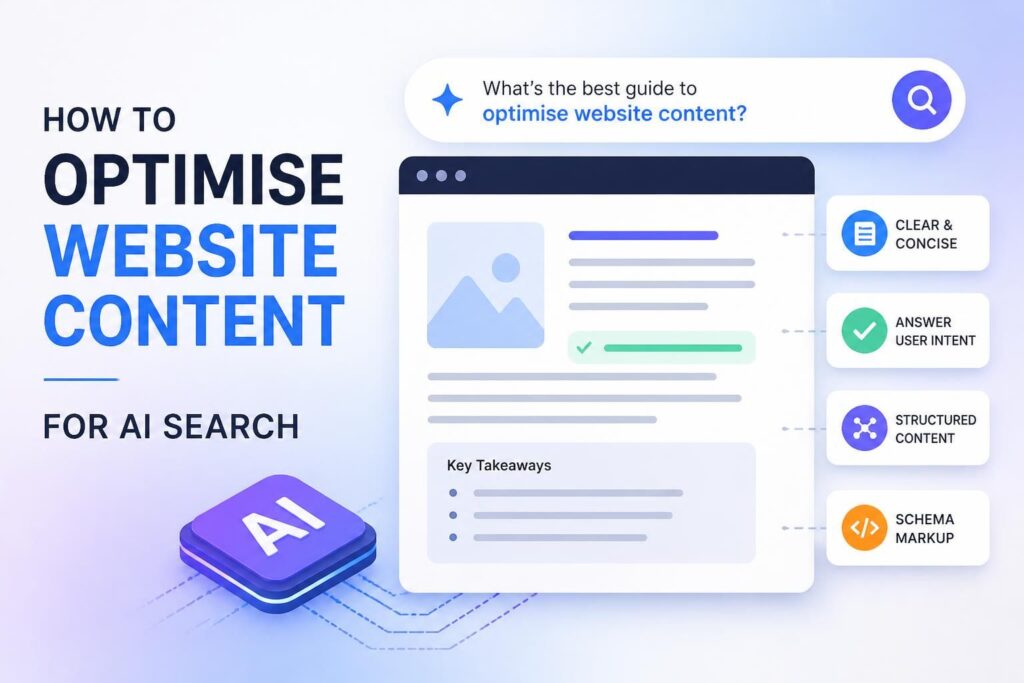





Optimising website content for AI search means making each page easy to find, interpret, verify and quote. The work combines sound search engine optimisation with clear answers, strong entity signals, reliable evidence, structured page design and technically accessible content. It is not a replacement for SEO. It is an extension of the same foundations that help search engines understand and trust a website.
For South African businesses, the practical goal is visibility wherever customers research a product, service or problem. That may include conventional Google results, AI Overviews, conversational search tools and answer engines. No method can guarantee that a page will be cited, but a well-organised and credible website gives search systems better material to retrieve and summarise.
Other Siteweb services that support online visibility
- Generative engine optimisation services for improving visibility across AI-assisted search experiences
- Search engine optimisation for stronger rankings, technical performance and organic traffic
- Google Business Profile optimisation for local discovery and accurate business information
- Google Ads campaign management for reaching customers with immediate commercial intent
- Social media marketing for distributing useful content and building brand recognition
How AI search selects and presents website information
AI-assisted search does not rely on a single ranking formula. Depending on the product and query, a system may retrieve pages from a search index, identify relevant passages, compare information across sources and generate an answer with links or citations. A page therefore needs to perform well at two levels: it must be discoverable as a document and understandable at passage level.
A conventional search result usually asks the user to choose a page. An AI-generated response may extract only part of that page. This changes how content should be written. A useful paragraph should identify its subject clearly, answer a specific need and remain accurate when read outside the surrounding section.
The term generative engine optimisation, often shortened to GEO, describes work intended to improve a brand’s presence in generative search results. GEO overlaps heavily with SEO because both depend on crawlable pages, relevant information, internal links, authority and a good user experience. Content created only for machines is unlikely to serve either goal well.
Start with the questions that influence a buying decision
Broad traffic is not the only measure of useful visibility. A business benefits when its content answers the questions prospective customers ask before choosing a service, comparing providers or requesting a quotation. Begin with a map of the customer’s decision process rather than a list of isolated keywords.
For example, a solar installer might cover system sizing, roof suitability, battery capacity, installation stages, warranty responsibilities and the difference between backup and grid-tied systems. An accounting practice could explain required records, service scope, deadlines, fee factors and the situations in which specialist tax advice is needed. These subjects give search systems specific information to associate with the business.
Useful research inputs include:
- Questions received through sales calls, contact forms and customer emails
- Search Console queries that already generate impressions
- Google’s related searches and question features
- Support requests and objections recorded by sales staff
- Competitor pages, reviewed for missing detail rather than copied wording
- Industry terminology used by customers and recognised professional bodies
Group related questions by intent. Someone asking for a definition needs a direct explanation. Someone comparing options needs criteria, limitations and trade-offs. A searcher looking for a provider needs evidence of service scope, location, process and a clear next step.
Write answers that remain clear when extracted from the page
A search system may quote or summarise a single passage, so avoid paragraphs filled with vague references such as “it”, “this solution” or “these services”. Name the business, service, product or process where clarification is needed. This does not mean repeating the same keyword in every sentence. It means removing ambiguity.
Place a concise answer near the beginning of a relevant section, then add explanation, examples and qualifications. If a reader asks how long a process takes, state the realistic variables before discussing your workflow. If no universal timeline exists, say so rather than inventing a precise figure.
Use a question-and-answer pattern selectively
Not every heading needs to be a question. Descriptive headings often provide stronger context. Use question headings for genuine customer queries and answer them promptly. A concise opening of about two or three sentences can serve readers who need a quick answer, while the paragraphs below support those making a more considered decision.
Make comparisons explicit
Comparison content is easier to interpret when the criteria are named. Instead of declaring that one option is better, explain the circumstances in which each option fits. A table can work for concise attributes, but it should not replace necessary explanation or become unreadable on a mobile screen.
Useful comparison criteria may include cost factors, implementation time, ongoing maintenance, ideal use case, limitations, contractual commitments and the expertise required. Accurate trade-offs create more value than promotional claims that could apply to any provider.
Build pages around identifiable entities
An entity is a recognisable person, organisation, place, product, service or concept. Clear entity information helps search systems connect a business with what it offers, where it operates and which subjects it knows about.
A South African service business should present its registered or trading name consistently where appropriate, along with its contact details, service categories and actual service area. The About page should explain the organisation rather than offering generic sales copy. Service pages should define each service, intended customer, process and deliverables without relying on readers to infer the details.
Consistency also matters across the website, Google Business Profile and reputable external listings. If names, telephone numbers or locations have changed, update outdated references where possible. A well-maintained Google Business Profile can strengthen local discovery, but it should reflect the business accurately rather than being filled with extra keywords.
Demonstrate expertise with evidence readers can evaluate
AI search optimisation is not achieved by repeatedly claiming expertise. A page becomes more credible when readers can inspect the reasoning, source and limitations behind its statements. Identify the author or responsible organisation, publish accurate service information and review content when facts change.
Evidence can include original research, transparent calculations, documented processes, case studies with permission, product specifications and links to primary sources. Do not fabricate statistics or imply that a general industry result guarantees the same outcome for every customer. Where a claim depends on location, product selection or individual circumstances, state that qualification.
Experience-based detail is particularly useful. A page explaining what information a customer must prepare, what commonly delays a project and how deliverables are assessed offers more practical value than a long definition assembled from other websites. Case studies should describe the starting problem, work completed and measured result while protecting confidential customer information.
Use a content structure that supports people and retrieval systems
A strong page has one clear purpose. The title identifies that purpose, the opening addresses the main need and the headings divide the discussion into meaningful sections. Short paragraphs improve scanning, but excessive fragments can make a complex explanation feel disconnected.
Use lists for steps, checks and genuine sets of options. Use ordinary paragraphs for reasoning and context. Headings should form a logical hierarchy: the WordPress post title normally supplies the H1, major sections use H2 elements and true subsections use H3 elements.
Each important service should have a dedicated page rather than being mentioned only in a long list on the home page. Supporting articles can then link to that service page when the reader needs professional help. Descriptive anchors such as improving visibility in generative search give users more information than vague anchors such as “click here”.
Strengthen topical coverage without producing repetitive pages
Topical authority does not mean publishing dozens of near-identical articles. Build a useful cluster around a core commercial subject, with each page answering a distinct intent. One comprehensive guide can cover the overall process, while separate pages address costs, comparisons, troubleshooting or industry-specific applications where there is enough unique information.
Before creating a new post, check whether an existing page should be improved instead. Competing pages on the same website can split links and confuse readers about which URL is authoritative. Consolidating overlapping articles may produce a stronger resource than adding another shallow page.
Internal links should reflect genuine relationships. Link from a broad guide to detailed resources and from supporting articles back to the central service or topic page. Orphaned content, which has no meaningful internal links pointing to it, is harder for users and crawlers to discover.
Technical SEO still determines whether content can be used
Clear writing cannot compensate for a page that search crawlers cannot access or render reliably. Confirm that important URLs return a successful status, are not blocked unintentionally and use the intended canonical address. Pages should work on mobile devices and load without forcing visitors through intrusive overlays.
A practical technical review should examine:
- Robots.txt rules and page-level robots directives
- Canonical tags, redirects and duplicate URL versions
- XML sitemap accuracy and update dates
- Internal links to high-value pages
- Mobile layout, page speed and Core Web Vitals
- JavaScript rendering of primary page content
- Broken links, server errors and soft 404 pages
- Image alternative text where an image conveys useful information
Policies for AI crawlers vary between services and can change. Review crawler documentation before setting access rules, and make a deliberate decision based on the website’s publishing and data policies. Blocking a crawler may limit how that service accesses content, while allowing access does not promise inclusion or citation.
Do not treat an llms.txt file as a shortcut
Some website owners publish an llms.txt file to offer language models a curated set of links or instructions. Adoption and support are not universal, and the file is not a substitute for crawlable pages, internal linking, sitemaps or robots controls. Treat it as an optional experiment only after the website’s established technical foundations are sound.
Add structured data that matches visible content
Structured data gives search engines machine-readable information about a page and its entities. Relevant types may include Organization, LocalBusiness, Service, Article and BreadcrumbList. FAQ markup should be used only when the questions and answers are visible on the page and comply with the search engine’s current policies.
Markup must describe what visitors can actually see. Do not add invented reviews, ratings, addresses, prices or qualifications. Structured data can improve interpretation and eligibility for certain search features, but it does not guarantee rankings, rich results or inclusion in an AI-generated answer.
Google maintains structured data guidance and testing tools for supported search features. Schema.org provides the wider vocabulary used to describe entities and relationships.
Create content that reflects the South African market
Local relevance comes from useful detail, not repeated place names. Use South African terminology, currency and examples when they apply. Explain the geographic limits of a service and distinguish between nationwide online delivery and work that requires an on-site visit.
Businesses serving several cities should avoid publishing location pages that differ only by the city name. A location page needs standalone value, such as an actual office, a defined service area, local project information, regional delivery conditions or customer guidance specific to that market.
Regulated subjects require particular care. Financial, legal, medical and safety-related content should be reviewed by an appropriately qualified person where necessary. Link to the responsible South African authority when it is the best source, and show the date of material that may change.
A practical workflow for optimising existing content
- Select commercially relevant pages. Start with pages that already receive impressions, generate enquiries or support an important service.
- Define one primary intent. Record the main question, the intended reader and the action the page should support.
- Compare the search results. Note the formats, concepts and questions that appear consistently, then identify missing practical detail.
- Check factual accuracy. Replace unsupported claims and add primary sources where evidence would help the reader.
- Rewrite the opening. Answer the central query promptly without a generic preamble.
- Improve passage clarity. Give each section a descriptive heading and enough context to make its main point understandable on its own.
- Add first-hand business information. Explain the actual process, inputs, deliverables, limitations and next steps without inventing results.
- Review entities and links. Confirm consistent business details and connect the page to relevant service and supporting pages.
- Test technical accessibility. Inspect indexing, canonicalisation, mobile usability, speed and rendered content.
- Measure and refine. Track search visibility, qualified visits, enquiries and assisted conversions, then update sections based on real behaviour.
Measure visibility beyond a single ranking report
AI-generated search results can vary by wording, location, personalisation and product. Citation tracking can provide useful observations, but it should not be presented as a complete or perfectly stable measure of brand visibility.
Use a balanced measurement set. Google Search Console can show changes in impressions, queries, pages and clicks from Google Search, although reporting may not isolate every generative feature. Analytics can reveal landing-page engagement and conversions. Lead forms and sales conversations can include a simple source question to capture discovery that software misses.
Useful measures include:
- Growth in impressions for relevant non-brand queries
- Visibility of priority service and comparison pages
- Qualified organic enquiries rather than traffic alone
- Mentions and citations observed across selected answer engines
- Conversions assisted by educational content
- New links or references earned from reputable websites
Record a baseline before substantial changes and annotate publication dates. Improvement may result from several factors, including content updates, stronger links, technical fixes, demand changes and search engine updates. Avoid attributing every movement to one optimisation task.
Common mistakes that reduce AI search visibility
- Publishing generic summaries that add no original expertise or evidence
- Creating many pages that target minor keyword variations with the same answer
- Hiding the main answer beneath a long promotional opening
- Using unsupported superlatives, statistics or performance promises
- Adding schema for information that is not visible on the page
- Ignoring author, business and contact information
- Allowing valuable articles to become outdated or internally orphaned
- Blocking crawlers accidentally during a redesign or security update
- Measuring success only by total traffic instead of relevant enquiries
Another mistake is writing awkward content specifically for a language model. Customers remain the audience. Clear language, credible evidence and useful detail benefit readers while also giving retrieval systems better source material.
Questions business owners ask about AI search content
Is AI search optimisation different from SEO?
It has a different emphasis but relies on the same core foundations. SEO supports crawling, indexing, relevance and authority. AI search optimisation gives extra attention to passage-level clarity, entity relationships, extractable answers and the evidence needed for a system to summarise a source confidently.
Can a business guarantee inclusion in an AI answer?
No. Search and answer platforms control which sources they retrieve, cite or summarise. A provider can improve technical access, content quality and topical relevance, but should not guarantee a citation, ranking position or volume of leads.
Should older articles be rewritten or replaced?
Improve the existing URL when it already has relevant links, impressions or history and still matches the intended topic. Replace or consolidate it when the content is inaccurate, duplicated or aimed at a different intent. Redirect removed URLs to the closest relevant page rather than automatically sending everything to the home page.
How often should website content be updated?
Update a page when its facts, process, products, links or search intent have changed. Fast-changing subjects may require frequent reviews, while stable explanatory pages can remain useful for longer. Set review dates according to the risk of outdated information instead of changing wording merely to create a new timestamp.
Does structured data make a page appear in AI search?
Structured data helps machines interpret information, but it does not guarantee selection. It works best when the visible page is accurate, crawlable and useful. Incorrect or misleading markup may be ignored and can create compliance problems for supported search features.
Turn useful content into qualified business enquiries
Content prepared for AI search should still help a person make progress. Give the reader a relevant next step: read a detailed service page, compare options, download a useful resource or request an assessment. Match the call to action to the stage of the decision rather than pushing every visitor directly into a sales conversation.
Siteweb Online Marketing can review how your website explains its services, how search engines access the content and where stronger topic coverage may support lead generation. The work may involve technical and content SEO, generative search optimisation, local profile improvements and a clearer conversion path.
If your website attracts traffic but does not explain your expertise clearly, contact Siteweb Online Marketing to discuss a practical content and search visibility review.
Authoritative resources
- Google Search Central guidance on helpful, reliable, people-first content
- Google documentation on robots.txt and crawler access
- The XML Sitemap protocol
- Schema.org structured data vocabulary