How to optimise website content for AI search
September 14, 2026
How to optimise a Google Business Profile for more leads
September 28, 2026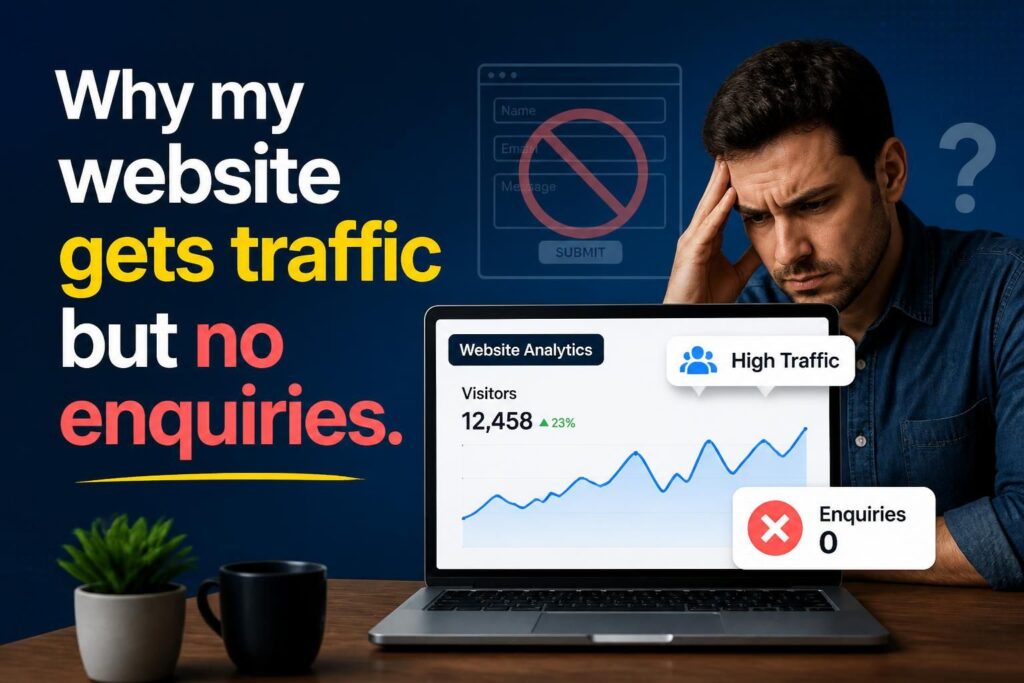




A website can attract hundreds or even thousands of visits without producing meaningful enquiries. Traffic alone does not create leads. Enquiries happen when the right visitor reaches a relevant page, understands the offer, trusts the business and can take the next step without unnecessary friction.
If your website gets traffic but no enquiries, the problem is usually found in one of five areas: traffic quality, search intent, the strength of the offer, website usability or conversion tracking. Diagnosing these areas separately will help you avoid spending more money on traffic before fixing the reason visitors are not converting.
Siteweb services that can improve visibility and lead generation
Siteweb Online Marketing helps South African businesses connect online visibility with measurable customer actions. Depending on where the problem lies, useful services may include:
- Google Business Profile optimisation for stronger local visibility and more direct calls, direction requests and website visits.
- Google Ads campaign management for reaching people actively searching for relevant services.
- Search engine optimisation focused on commercially relevant rankings rather than traffic alone.
- Generative engine optimisation to make business information clearer and easier for AI-powered search platforms to interpret.
- Social media marketing that supports awareness, audience engagement and demand generation.
Why website traffic does not automatically produce enquiries
Website traffic measures visits, not buying intent. A person reading a general educational article may be useful to your wider marketing strategy, but that person is less likely to enquire immediately than someone searching for a provider, price, quotation or solution in their area.
The same distinction applies to traffic sources. Organic search, paid advertising, social media, referral links and direct visits can each bring people with different expectations. A social media visitor may be discovering your brand for the first time, while a visitor searching for a specific service may already be comparing suppliers.
A healthy lead-generation website therefore needs more than rising visitor numbers. It needs suitable visitors, pages aligned with their needs, credible reasons to choose the business and clear conversion paths. If any part of that sequence fails, traffic can increase while enquiries remain unchanged.
Start by checking whether the traffic is relevant
The first question is not how much traffic the website receives. It is whether those visitors could realistically become customers. A South African service business may attract large amounts of international traffic from an informational article, for example, even though it only serves local customers.
Review traffic by source, landing page, location, device and search query where the data is available. Look for patterns rather than judging the entire website by one headline number.
- Geographic relevance: Are visitors located in South Africa or within the areas the business can serve?
- Commercial relevance: Do landing pages address services the business sells, or are most visits going to broad informational content?
- Search intent: Are people researching a topic, comparing providers or ready to request help?
- Traffic source: Which channels bring engaged visitors and which produce brief, low-value sessions?
- Device quality: Are mobile users encountering problems that desktop visitors do not experience?
High traffic to an unrelated article can make the website appear successful while hiding weak performance on service pages. Segment reports so that blog traffic, branded searches, service-page visits and paid campaigns can be assessed independently.
Your pages may be targeting the wrong search intent
Search intent describes what a person wants to achieve with a query. A page can rank for a phrase and still fail commercially if its content does not match that goal.
Someone searching for “what is SEO” is mainly seeking information. Someone searching for “SEO company South Africa” is more likely to be evaluating providers. A visitor searching for “SEO quotation” may be closer to contacting a business. These searches belong to the same broad subject, but they need different pages and calls to action.
Review the main query or advertising keyword associated with each landing page. Then compare that intent with what the page offers. A commercial search should normally lead to a focused service page containing the information a buyer needs, rather than a generic home page or loosely related blog post.
Signs that search intent and landing pages are misaligned
- The page receives impressions and clicks for questions unrelated to the service being sold.
- Visitors arrive on a blog article but have no relevant route to a service page.
- A paid advertisement promises a specific service while the landing page discusses several unrelated services.
- The page ranks nationally even though the business serves only a limited geographic area.
- Visitors repeatedly search the website for basic information that should be visible on the landing page.
Informational traffic is not inherently poor-quality traffic. Useful articles can establish expertise and introduce potential customers to a business. They simply need relevant internal links and a sensible next step. The call to action should match the reader’s stage: read a related service page, review the process, request an assessment or contact the business.
The offer is unclear or too generic
A visitor should be able to determine what the business does, who it helps and what action to take within a few moments of arriving on a key page. Statements such as “we deliver quality solutions” provide little practical information because almost any competitor could say the same thing.
Clear service-page copy answers the questions buyers use to assess fit. What problem does the service solve? Which customers is it intended for? What is included? How does the process work? What information is required to get started? What happens after an enquiry?
Visitors may hesitate when a website asks them to “get in touch” without explaining what they will receive. A more specific invitation, such as requesting a website lead-generation review or discussing a Google Ads campaign, reduces uncertainty. The business should only promise a review, quotation or response time if it can consistently provide it.
Weak calls to action leave interested visitors without a next step
A call to action should tell the visitor what to do and set a reasonable expectation about what follows. It should also appear at points where a visitor may be ready to act, not only in the website footer.
Different pages may require different actions. A detailed service page can invite the reader to request a consultation, while an educational article may first direct the reader to a relevant service. For mobile visitors, a visible contact button can be useful, provided it does not obstruct the content.
Review calls to action for specificity, prominence and relevance. Avoid presenting too many competing choices in the same section. If a visitor is simultaneously asked to call, email, download a file, follow several social accounts, join a mailing list and request a quote, the lack of hierarchy can reduce action.
Trust is missing at the point of decision
Prospective customers often visit a website to reduce risk before making contact. They want evidence that the business understands their problem, operates legitimately and can explain its approach clearly.
Trust cannot be created by adding unsupported claims. It comes from accurate contact information, consistent branding, clear service descriptions, transparent processes and verifiable proof. Depending on the business, useful trust signals may include genuine customer reviews, named case studies, team information, project examples, professional memberships or links to active business profiles.
Do not publish invented testimonials, vague client logos or results without context. A credible case study should explain the starting problem, the work completed and the outcome that can be supported. If customer confidentiality limits the detail, describe the type of project without making unverifiable claims.
Technical and usability problems may be blocking conversions
A person can be interested in a service and still abandon the website if the next step is difficult. Test the full enquiry journey on a real mobile phone as well as a desktop computer. Do not assume that a form works because it looks correct in the website editor.
Common conversion barriers include:
- Forms that fail to submit or show unclear error messages.
- Contact buttons that are difficult to find or do not work on mobile devices.
- Pages that load slowly on typical mobile connections.
- Pop-ups that cover the page or prevent visitors from reaching the form.
- Phone numbers that cannot be tapped on a smartphone.
- Forms requiring unnecessary personal information before an initial conversation.
- Missing confirmation messages, leaving visitors unsure whether the enquiry was sent.
- Navigation labels that make service information difficult to locate.
Form submissions should also be checked beyond the browser. Confirm that notifications reach the correct inbox, are not being filtered as spam and contain enough information for follow-up. Send test enquiries regularly and record whether each one reaches the intended recipient.
Your enquiry form may be asking for too much
Every required field creates extra effort and may introduce privacy concerns for the visitor. An initial lead form usually needs enough information to identify the person, understand the request and respond through an agreed channel. It does not necessarily need a full project brief, budget, physical address and several qualifying questions.
The right form length depends on the service. A high-value or technically complex project may justify qualification questions, while a straightforward local service may benefit from a shorter form. If detailed information is genuinely needed, explain why it is being requested and separate optional fields from required ones.
Businesses collecting personal information should handle it responsibly and provide clear privacy information appropriate to their operations. Legal requirements depend on the circumstances, so obtain qualified advice where needed rather than relying on a generic form template.
Mobile visitors may be having a different experience
South African customers frequently research businesses and make contact from mobile devices. A website that appears polished on a large office monitor may have cramped text, awkward menus, slow images or inaccessible buttons on a smaller screen.
Check key landing pages at several common screen sizes. Read the page from top to bottom, use the navigation, tap the phone and email links, complete every form field and submit a test enquiry. Pay attention to sticky banners and chat widgets, which can occupy a large portion of a mobile display.
Mobile optimisation is not only about passing an automated test. The real question is whether a prospective customer can understand the offer and contact the business comfortably without zooming, hunting for information or correcting avoidable form errors.
Conversion tracking may be inaccurate or incomplete
Sometimes enquiries are happening but the reporting does not capture them. In other cases, analytics records button clicks as leads even though no completed enquiry occurred. Decisions based on faulty tracking can send budget towards the wrong campaign.
Define what counts as a genuine conversion before configuring reports. Suitable conversion actions may include a successfully submitted form, a qualified phone call, a completed booking or a meaningful messaging interaction. A visit to the contact page is a useful engagement signal, but it is not the same as an enquiry.
Compare website analytics with actual form notifications, call records, customer relationship management data and sales outcomes. This helps reveal broken tracking as well as the quality of the leads being generated. Where possible, retain the original source or campaign information so that enquiries can be connected to marketing activity.
A practical website lead-generation audit
Use the following process before buying more traffic. It moves from measurement to diagnosis and then to controlled improvement.
- Verify every conversion route. Submit each form, click every contact method and confirm that notifications reach the correct person.
- Separate traffic by landing page and source. Identify which pages attract potential buyers and which primarily serve informational visitors.
- Review geographic and audience fit. Check whether visitors are located in markets the business can serve and match the intended customer profile.
- Compare the query with the page. Confirm that organic search terms and paid keywords lead to content matching the visitor’s intent.
- Assess the offer. Make sure the page explains the service, intended customer, process and next step in specific language.
- Test the mobile experience. Complete the journey on a real phone using a normal mobile connection.
- Inspect trust signals. Remove unsupported claims and add verifiable information that helps a buyer assess the business.
- Choose one meaningful improvement. Change the weakest element first rather than redesigning everything simultaneously.
- Measure lead quality as well as volume. Record whether enquiries are relevant, reachable and commercially suitable.
This approach makes it easier to identify cause and effect. If traffic, page copy, forms and advertising are all changed at once, it becomes difficult to know what improved or damaged performance.
How to tell where the problem is
Different performance patterns point to different likely causes. High traffic with very few visits to service or contact pages often indicates weak internal journeys or low commercial intent. Frequent contact-page visits without submissions suggest form friction, missing trust information or an unclear offer. Form submissions that never become conversations may indicate poor lead quality, slow follow-up or targeting that is too broad.
Paid campaigns with clicks but no conversions should be reviewed at keyword, advertisement and landing-page level. Broad targeting can bring people interested in a related subject but not the actual service. Search terms, location settings, negative keywords and conversion actions all deserve attention before increasing the budget.
If organic traffic is growing mainly through blog content, build deliberate paths from useful articles to relevant commercial pages. This should help readers continue their research rather than forcing a sales message into every paragraph.
What to improve first
Prioritise problems according to impact and confidence. A broken form should be fixed before rewriting a headline. Irrelevant paid traffic should be corrected before commissioning a full website redesign. Missing conversion tracking should be addressed before judging whether a campaign is successful.
A useful order of work is:
- Repair broken forms, buttons and tracking.
- Stop clearly irrelevant traffic and advertising spend.
- Improve the message and call to action on high-intent landing pages.
- Add credible information that answers common buyer concerns.
- Strengthen links between educational content and service pages.
- Test one significant change at a time and review lead quality.
Do not rely on bounce rate or time on page as isolated measures of success. A visitor may find a phone number quickly and leave, while another may spend several minutes reading without any intention of buying. Evaluate behaviour alongside completed actions and sales feedback.
Questions business owners ask about low website enquiries
How much traffic does a website need before it generates leads?
There is no universal traffic threshold. A website with a small number of highly relevant visitors can generate more enquiries than a high-traffic site attracting broad or international audiences. Measure conversion performance by landing page, source and visitor intent rather than assuming that more sessions will solve the problem.
Why do people visit my contact page but not submit the form?
The form may be too long, technically broken or unclear about what happens next. Visitors may also be looking for a phone number, physical location or email address. Test the page on mobile, reduce unnecessary fields and confirm that the offer provides enough trust and context.
Can SEO bring traffic but no customers?
Yes. SEO can increase traffic from informational, irrelevant or geographically unsuitable searches if keyword and content decisions are based only on search volume. Effective SEO should connect relevant queries to pages that satisfy the search intent and support a realistic customer journey.
Should I redesign my website if it is not generating enquiries?
Not automatically. First verify tracking, traffic quality, forms, mobile usability and the offer. A redesign may be appropriate when the structure or technology prevents improvement, but many websites need focused landing-page and conversion changes rather than a complete rebuild.
How quickly should a business respond to a website lead?
Respond as soon as the business can do so accurately and consistently. Prospects may contact several providers, so avoid leaving qualified enquiries unattended. Set an internal process for ownership, notifications and follow-up, and publish a response-time promise only if the business can meet it.
Turn website visits into measurable business opportunities
A traffic problem and a conversion problem require different solutions. If the right people are not arriving, targeting and visibility need attention. If suitable visitors arrive but do not act, the website’s message, trust, usability and contact journey need to be examined. If enquiries occur but reports show none, tracking and lead-handling processes need repair.
Siteweb Online Marketing can review how your traffic sources, landing pages and conversion routes work together. The aim is not simply to increase visits, but to identify where potential customers are being lost and which improvements are most likely to produce relevant leads. Contact Siteweb to discuss your website’s lead-generation performance and the marketing channels supporting it.